
Introduction
Dubai’s real estate market continues to draw attention from investors around the world. In 2026, the city’s property sector shows strong growth and stability. This makes it an exciting time for anyone looking to invest here.
But here is the thing. Many property projects in Dubai still fail. Why? They jump in without a solid plan. A good marketing go to market plan can make the difference between success and failure.

Without one, even the best property can sit unsold or unloved.
So what is a market plan exactly? In simple terms, it is your roadmap for bringing a property to buyers or renters. A got to market plan covers everything from pricing to promotion. It helps you know who your buyers are, what they want, and how to reach them.
Many investors skip this step. They focus on finding a good deal first. But without a clear what is market plan approach, they end up guessing. And guessing in a market like Dubai can cost you a lot.
A data-driven GTM plan changes that. It uses real numbers and trends to guide your choices. For more on how to use data in your marketing, check out this guide on data-driven digital marketing for Dubai real estate.
This approach lowers your risk and boosts your chances of strong returns. You stop hoping and start knowing.
If you are thinking about investing in Dubai real estate in 2026, you need more than luck. You need a plan that works. And that starts with good information and expert advice. Connect with a professional who knows the market inside out through a FREE Dubai Real Estate Consultation.
Why a Structured Go-to-Market Plan is Critical for Dubai Real Estate Success
You might wonder why a simple roadmap matters so much. In Dubai’s fast-paced property market, a structured go-to-market plan does three big things that guessing cannot match.
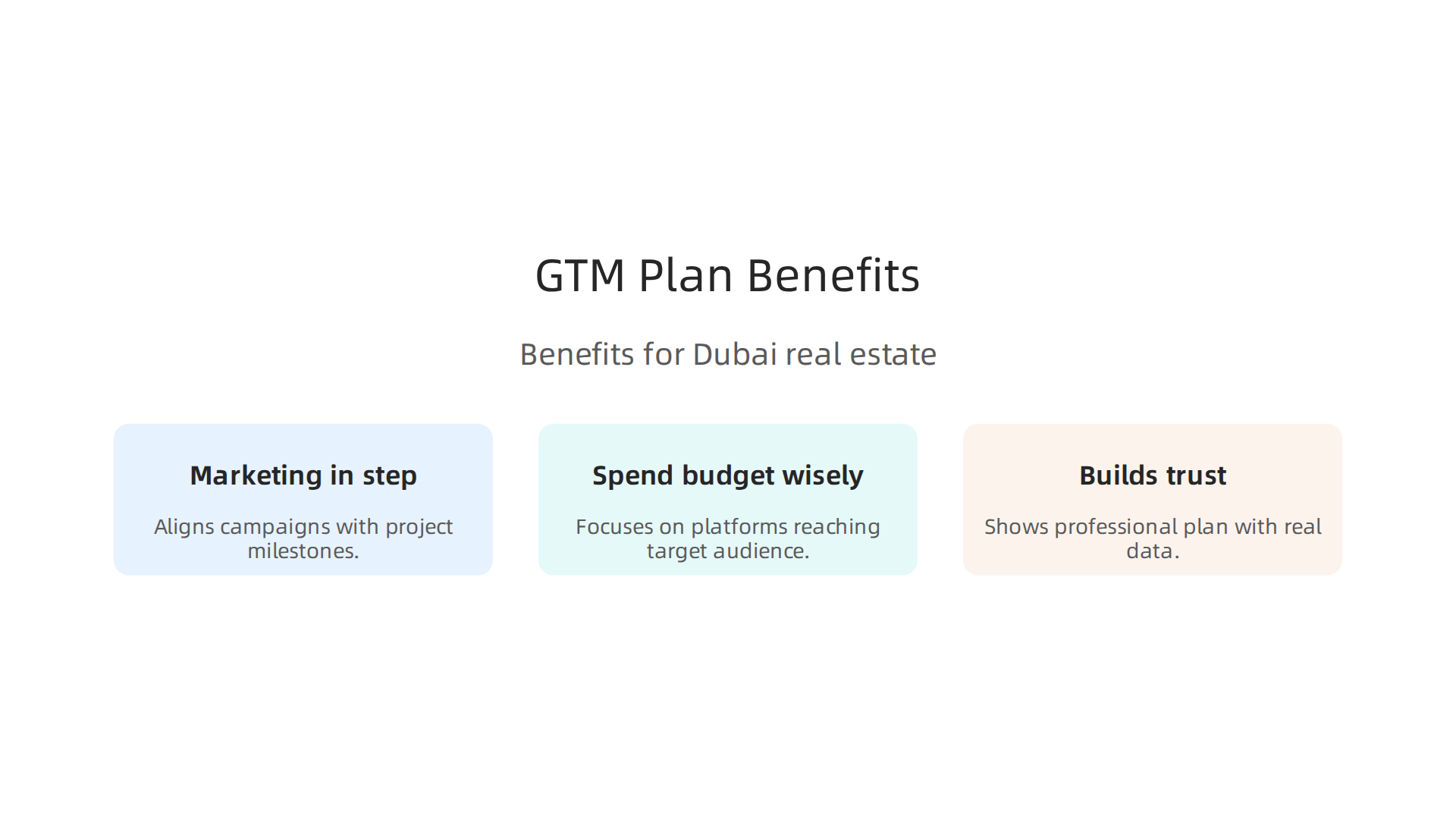
First, it keeps your marketing in step with your project milestones. Imagine launching ads for a villa community before construction even starts. You waste money and confuse buyers. A good marketing go to market plan ties every campaign to actual construction phases, handover dates, and investor expectations. This way, you reach buyers exactly when they are ready to commit.
Second, it helps you spend your budget where it counts. Instead of throwing money at every channel, a clear plan tells you which platforms, events, or agents will reach your target audience. You stop burning cash on tactics that do not work. For example, if your buyers are mostly expat families, you focus on family-friendly communities and school proximity. This smart allocation of resources is a core part of any effective what is a market plan approach.
Third, it builds trust with investors and other stakeholders. When you show a professional plan with real data and clear timelines, people feel confident putting their money with you. Developers, banks, and partners all want to see that your got to market plan is solid. A strong framework like the one described in this go-to-market strategy framework for 2026 lays out exactly how to define your market and set your pricing.

That kind of detail turns a simple idea into a credible investment.
In short, a structured plan turns uncertainty into a clear path forward. And when you have confidence in your strategy, your investors will too. To learn more about building a long-term wealth plan that works in this market, check out this guide on build wealth with Dubai real estate investment.
Phase 1: Market Research and Buyer Persona Development
Every strong marketing go to market plan starts with knowing the market inside out. Phase 1 is all about digging into the data so you can spot real trends and opportunities, not just guess.
For Dubai in 2026, that means looking at real numbers. The Housing Prices in Dubai 2026 report shows the median home price sits around AED 2.1 million. But prices vary a lot by area and property type. Another analysis from Engel & Völkers on the Dubai Housing Market 2026 confirms that villa prices have led growth, with demand staying strong in low-density communities. Understanding these patterns helps you choose where to position your project.
You also need to study the competition. Who else is selling similar properties nearby? What prices are they asking? What do buyers like or dislike about those developments? This is a key part of answering what is a market plan in practice.
Finally, you build detailed buyer personas. Are your buyers young expat professionals looking for studios? Or families wanting villas near good schools? Each group has different needs. A clear got to market plan uses these personas to guide every marketing decision.
Once you have solid research, the next logical step is to explore specific investment opportunities that match your findings. To dive deeper into current market opportunities, read our data-backed guide to the Dubai property market in 2026.
And if you are ready to take action on your research, get a FREE Dubai Real Estate Consultation to talk through your specific goals with an expert.
Analyzing Dubai’s Micro-Markets and Trends
After you understand the big picture, it is time to zoom in. A strong marketing go to market plan looks at individual neighborhoods, not just the whole city. This is sometimes called micro-market analysis, and it is a key part of any good what is market plan process.
Why does this matter? Because two communities next to each other can behave very differently. Take Dubai Marina and Downtown Dubai. Both are popular. But one might see faster price growth while the other offers better rental yields. You need to know these differences before you spend money.
Here are the key indicators to watch for each micro-market in 2026:
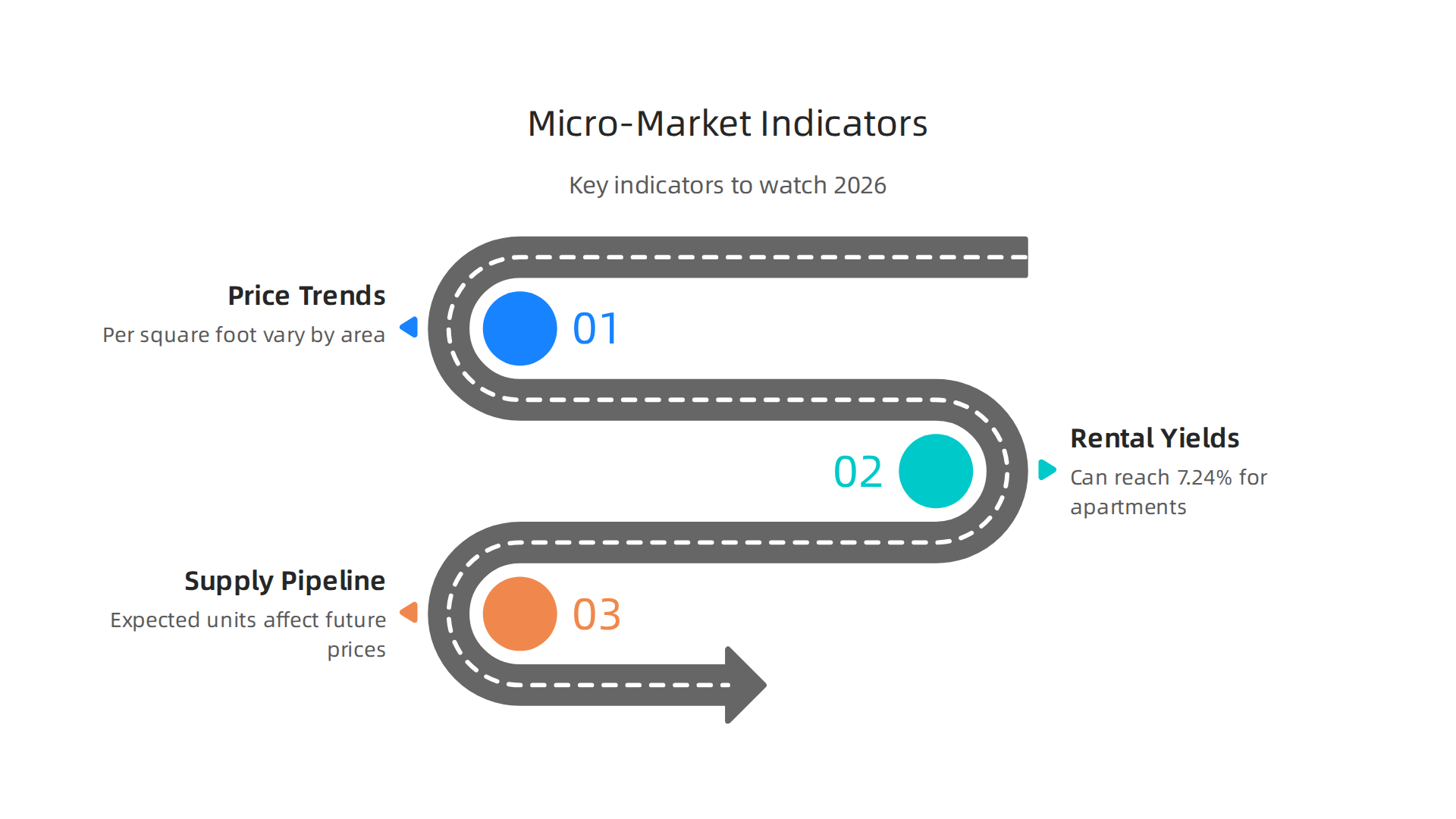
- Price trends per square foot: Some areas like Palm Jumeirah still command high prices, while newer communities offer better entry points.
- Rental yields: According to the United Arab Emirates’ Residential Property Market Analysis 2026, apartment yields in Dubai can reach as high as 7.24%, while villas average around 4.95%. That is a big gap.
- Supply pipeline: The Dubai property price rise or fall forecast for 2026 notes that around 83,000 units are expected to be completed, but historical patterns suggest the real number will be lower. That affects supply and prices.
This kind of detailed research is exactly how you build a smarter got to market plan. To see which communities are performing best right now, check out our analysis of the real estate market in Dubai for 2026 to invest with confidence.
Defining Your Ideal Investor Profile
Building a marketing go to market plan starts with one crucial step: knowing your audience. Some people ask, what is a market plan exactly? It is simply a roadmap that matches your product to the right buyer. In Dubai’s 2026 real estate market, you have a few main groups to think about.
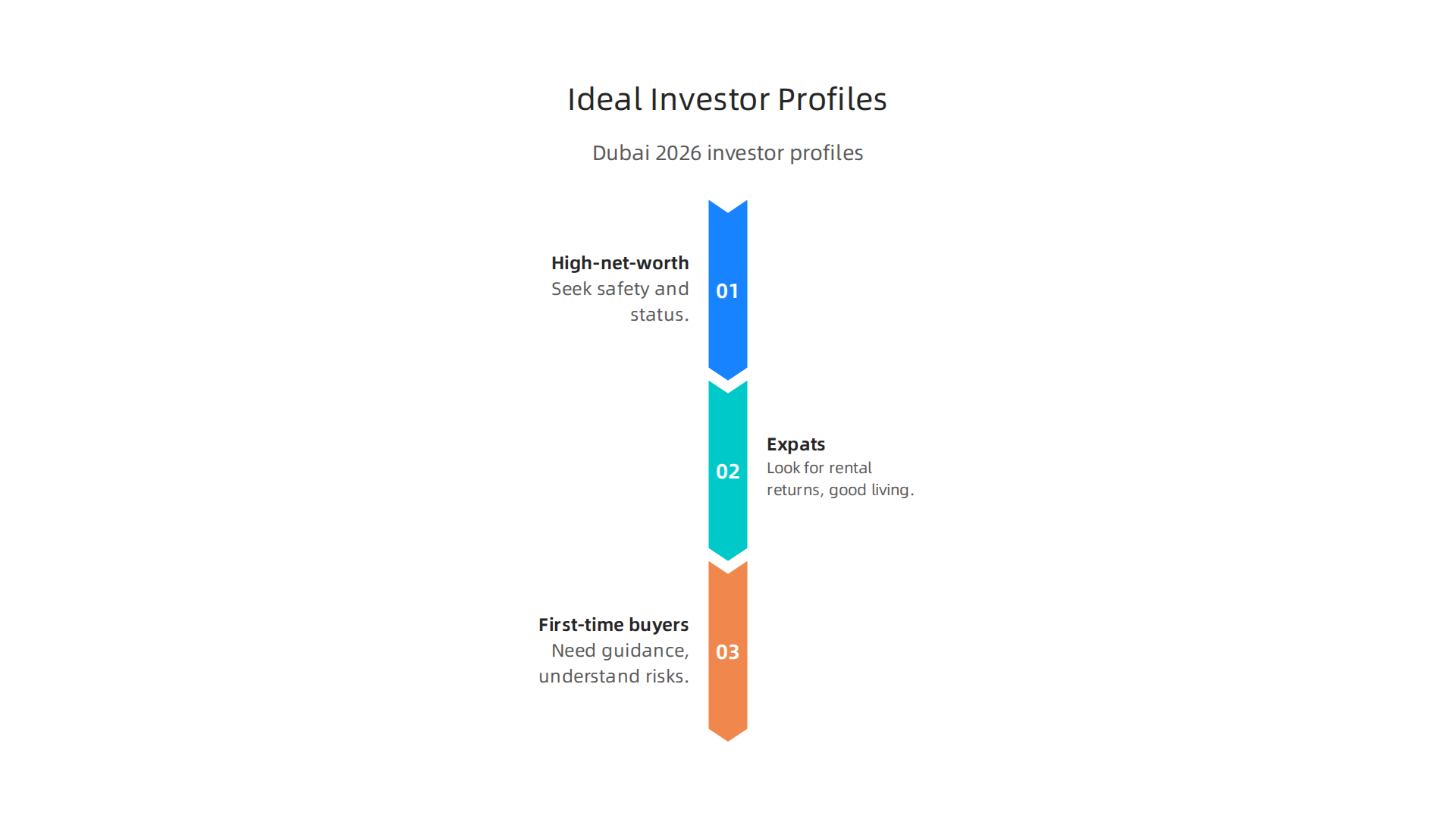
High-net-worth individuals look for safety and status. They buy luxury villas on Palm Jumeirah or branded homes in Dubai Marina. They want to keep their money safe, not just earn rent. As the data shows, high-net-worth individuals buying property in Dubai choose the city for its security and lifestyle. Your message to them should talk about privacy, long-term value, and tax perks.
Expats want something different. They look for good rental returns and a nice place to live. Many British, European, and Asian buyers shop for mid-market homes in areas like Jumeirah Village Circle or Dubai Silicon Oasis. They care about schools, travel time to work, and community vibe. Your pitch should focus on day-to-day living benefits.
First-time buyers need more guidance. They often have doubts and lots of questions. They want to learn the process, understand the risks, and see the possible returns.
A complete got to market plan builds a separate message for each group. It also picks the right way to reach them. HNWIs like private events and personal referrals. Expats use property websites and social media. First-timers read online guides and reviews before they reach out.
To sharpen your approach, check out our guide on digital marketing strategies for Dubai real estate investors.
If you are ready to match your message to the right buyer, get a FREE Dubai Real Estate Consultation with an expert who can help you define your audience and build the right pitch.
Phase 2: Crafting Your Unique Value Proposition and Messaging
Now that you know your audience, it is time to answer one big question: why should they pick your property over all the others?

That is where your unique value proposition (UVP) comes in. Your UVP is the one thing that makes your project stand out. It is not just a list of features. It is a promise that speaks directly to what each buyer cares about most.
Think about the three groups we covered earlier. For a high-net-worth individual, the UVP might be "prime location with total privacy and Dubai’s safest title deed." For an expat parent, the UVP could be "a family home within walking distance of top-rated British schools and a big park." For a first-time buyer, the UVP might be "the lowest entry price in the community with guaranteed rental income for the first year." Each message hits a different priority.
A complete marketing go to market plan maps these UVPs to specific buyer personas and channels. Many teams fail here because they try to say everything to everyone. Instead, pick one core message per group and stick to it. According to how to create a winning go-to-market strategy in 2026, the third step is to craft a unique value proposition that translates your capabilities into outcomes customers care about. That is exactly what you are doing.
In your messaging, use the words your buyers use. If they talk about "safe investment" or "best school zone," use those phrases. Avoid vague real estate buzzwords. Make every sentence feel like it was written for that one person.
To see how data-backed messaging works in practice, check out our guide on the real estate market Dubai 2026 invest with confidence. It shows how good positioning turns market facts into buyer trust.
Phase 3: Differentiating in a Crowded Market
After defining your UVP and messaging, the next step is to figure out how you stand apart from every other property in Dubai. The real estate market here is huge. Hundreds of new developments launch every year. If your project looks and sounds like everyone else, buyers will forget it fast.
So what makes a property truly different? Usually it comes down to a few things: location, amenities, developer reputation, or investment benefits. A prime spot near the beach or a top school zone is a strong differentiator. A building with a rooftop pool, gym, and concierge service stands out against basic units. A developer with a proven track record of finishing on time builds trust. And guaranteed rental income or flexible payment plans appeal to investors looking for low risk.
But you cannot guess what matters most. You need data. That is where competitor analysis comes in. Look at similar projects in your area. What do they offer? What do buyers complain about most in their reviews? Those complaints are your opportunities. If nearby buildings lack parking or green space, you can make those your headline features.
A full competitive mapping helps you find market gaps. According to the Go-to-Market Strategy 2026: The 5-Component Framework, market research reveals where opportunity exists and where competitors fall short. That insight feeds directly into your positioning. Your marketing go to market plan should identify these gaps and turn them into core selling points.
For example, if you notice most competing properties emphasize luxury but ignore family-friendly amenities, you can position yours as the best option for families with kids. That is a clear gap you own.
To see how this plays out in practice, check out our analysis on Abu Dhabi apartments for sale in 2026 your practical buyer roadmap. It shows how understanding competition leads to smarter marketing.
Ready to get specific about your own property? Buying, selling, renting, or investing in Dubai? Connect with Ayaz Salman for FREE Dubai Real Estate Consultation. He can help you find the differentiator that works for your goals.
Phase 3: Differentiating in a Crowded Market
After defining your UVP and messaging, the next step is to figure out how you stand apart from every other property in Dubai. The real estate market here is huge. Hundreds of new developments launch every year. If your project looks and sounds like everyone else, buyers will forget it fast.
So what makes a property truly different? Usually it comes down to a few things: location, amenities, developer reputation, or investment benefits. A prime spot near the beach or a top school zone is a strong differentiator. A building with a rooftop pool, gym, and concierge service stands out against basic units. A developer with a proven track record of finishing on time builds trust. And guaranteed rental income or flexible payment plans appeal to investors looking for low risk.
But you cannot guess what matters most. You need data. That is where competitor analysis comes in. Look at similar projects in your area. What do they offer? What do buyers complain about most in their reviews? Those complaints are your opportunities. If nearby buildings lack parking or green space, you can make those your headline features.
A full competitive mapping helps you find market gaps. According to the Go-to-Market Strategy 2026: The 5-Component Framework, market research reveals where opportunity exists and where competitors fall short. That insight feeds directly into your positioning. Your marketing go to market plan should identify these gaps and turn them into core selling points.
For example, if you notice most competing properties emphasize luxury but ignore family-friendly amenities, you can position yours as the best option for families with kids. That is a clear gap you own.
To see how this plays out in practice, check out our analysis on Abu Dhabi apartments for sale in 2026 your practical buyer roadmap. It shows how understanding competition leads to smarter marketing.
Ready to get specific about your own property? Buying, selling, renting, or investing in Dubai? Connect with Ayaz Salman for FREE Dubai Real Estate Consultation. He can help you find the differentiator that works for your goals.
Key Messages for Different Investor Types
Once you have your differentiator clear, you need to speak directly to the people who will buy. Not all investors care about the same thing. Some want safety above all. Others chase the highest yield. A few care most about transparency and trust. Your marketing go to market plan must tailor messages to each type.
Let us look at three common investor personas.
The Security Seeker. This person worries about losing money. They want stability and a proven track record. Your message should focus on low-risk factors like strong developer history, prime location with steady demand, and long-term capital preservation. In 2026, many wealthy individuals choose Dubai specifically for its political and economic safety. As highlighted in a piece about Why High-Net-Worth Individuals Are Buying Property in Dubai, the city offers the privacy and security of a gated environment. Lead with words like "safeguard," "stable returns," and "proven market."
The Yield Hunter. This investor compares rental income across markets. They want numbers. Your message must highlight gross rental yield (6–9% in Dubai), zero income tax on rent, and no capital gains tax. Show them exactly how much net profit they can keep. Use data from sources that confirm how Dubai’s tax efficiency boosts returns. For example, the Why Global Investors Are Choosing Dubai Real Estate in 2026 article explains that no capital gains tax, property tax, or tax on rental income allows investors to retain a higher portion of returns.

Your marketing go to market plan should include calculators or charts that let them see the math.
The Transparency Fan. This investor does their homework. They want clear processes and honest data. They are turned off by hype. You need to show them regulations, legal frameworks, and step-by-step buying guides. Use language like "data-driven," "registered with RERA," and "full disclosure." If you want to understand what a market plan includes for this group, it means publishing verified facts and avoiding fluff.
The channels you use also change by persona. Security seekers respond to authoritative blog posts, YouTube interviews with developers, and email newsletters. Yield hunters love short videos, comparative charts on Instagram, and direct WhatsApp messages with ROI breakdowns. Transparency fans prefer in-depth guides, downloadable PDF reports, and one-on-one calls where they can ask hard questions.
For a deeper look at how to match messaging with the right buyer profiles, check out our guide on freehold property dubai for foreign investors a 2026 roadmap to buying. It breaks down what different types of buyers need to hear at each stage.
When you build your marketing go to market plan, remember this: one message does not fit all. Split your audience into these personas. Write specifically for each. That is how you earn trust and close more deals.
Phase 3: Selecting the Right Marketing Channels and Tactics
You know your investor personas. Now you need to reach them where they actually look. The security seeker may spend time on YouTube watching developer interviews. The yield hunter scrolls Instagram for quick ROI charts. The transparency fan searches Google for detailed guides. Your marketing go to market plan must match each channel to the right buyer.

An omnichannel approach works best. That means using a mix of digital ads, email, SEO, events, PR, and partnerships. When a prospect sees your property on Instagram, then reads a blog post, and later gets an email from you, trust builds faster. A complete UAE real estate marketing plan for 2026 outlines exactly how to budget for these channels: digital advertising, organic content, email, and traditional media. Each channel plays a role.
Digital channels like Google Ads and Meta ads bring in leads fast. SEO and content marketing build lasting authority. Events and PR create credibility, especially for off-plan projects. And partnerships with international brokers or relocation agents open doors to foreign investors.
For a deeper dive into which digital tactics work best, read our guide on data-driven digital marketing for Dubai real estate investors. It breaks down how to allocate your efforts across paid and organic channels.
The key is to test, measure, and adjust. Start with three or four channels. Track where your best leads come from. Then put more budget into what works. That is how you turn a marketing go to market plan into real results.
Digital Marketing Strategies for Dubai Real Estate
Dubai has one of the highest rates of digital adoption in the world. Most investors start their property search on a phone or laptop. This makes online channels a critical part of any marketing go to market plan. Let us break down the strategies that work best in 2026.
First, SEO and content marketing. When an investor searches "luxury villas Dubai 2026 price", you want your site to show up. According to the 2026 Residential Construction Marketing Report, SEO has delivered some of the highest returns for real estate marketers this year. It is a long term play that brings in consistent, free traffic.
Second, paid ads. Google Ads and Meta Ads let you target specific investor personas. You can show a "security seeker" an ad for a completed, rented building while showing a "yield hunter" a flashy off-plan ROI chart. PPC works fast.
Third, email and social media. These channels help you build a relationship over time. Share market updates, new project launches, and virtual tour links. For a list of the best places to publish your content, see our guide to the top branded real estate platforms in the UAE for 2026.
Virtual tours are the final piece. They allow international buyers to explore a property without leaving their home country. This is essential for the Dubai market where many buyers live overseas.
Putting these five pieces together creates a complete digital strategy. If you need help building your own marketing go to market plan for 2026, connect with Ayaz Salman for a Free Consultation to discuss buying, selling, renting, or investing in Dubai.
Offline and Partnership Channels
Digital marketing is powerful, but it is not the only way to reach buyers in Dubai. Offline channels still play a big role, especially for serious investors who want to see a face or touch a brochure. A smart marketing go to market plan blends both worlds.
Property exhibitions are a prime example. Events like Cityscape Global bring thousands of investors together under one roof. Having a booth with a model of your project, a friendly agent, and clear pricing can close deals faster than any ad. It is where the "what is a market plan" question gets answered in person.
Broker partnerships are another must. Many international investors work with agents back home first. If you build a network of trusted brokers in key markets like India, the UK, or China, they send qualified leads your way. This is a high-trust got to market plan that works year after year.
Direct mail still works too. A well designed postcard or brochure mailed to a targeted list of past buyers or high net worth individuals reminds them you exist. Combine it with a QR code that leads to a virtual tour for best results.
Local events and sponsorships build brand presence in Dubai itself. Sponsor a community festival, host a networking dinner, or partner with a luxury car brand for a joint event. When people see your name at a real world gathering, they remember you when they start searching online.
For a deeper look at how to structure your overall marketing budget and plan across both online and offline channels, check out the How to Create a Real Estate Marketing Plan For 2026 in the UAE guide. It covers everything from international roadshows to RERA compliance.
And if you are ready to build your own complete marketing go to market plan for 2026, explore our guide on how to start a real estate business in Dubai for step by step advice on building your strategy from the ground up.
Phase 4: Budgeting, Timelines, and KPIs
If you are asking what is a market plan and how to fund it, the answer starts with your budget. A marketing go to market plan only works when your money and time are mapped out correctly. In Dubai real estate, that means aligning your budget with each project phase and setting realistic timelines.
Most developers spend between 7% and 12% of their Gross Commission Income on marketing according to the 2026 real estate marketing budget report. For off-plan projects in Dubai, that number often sits at the higher end because of international roadshow costs and multilingual content needs.
Your budget should match your milestones. Pre-launch needs heavy brand awareness spend. Launch phase shifts to lead generation and conversion ads. Post-launch focuses on referral programs and retargeting. Each phase requires a different split of your total marketing spend.
Timelines are just as tricky as the numbers. Regulatory approvals from RERA can take months. Construction delays happen often in large developments. A strong got to market plan builds buffer time into each phase so you are not spending money before you have official approval to sell.
Set clear KPIs from day one and review them every month. Track cost per lead, conversion rate, and return on ad spend as your primary metrics. If a channel is not delivering, shift that budget to a higher performing option without waiting.
For a full look at current market trends to guide your planning, check out this Dubai property market 2026 guide.
And if you want expert help planning your investment strategy, connect with Ayaz Salman for a FREE Dubai Real Estate Consultation.
Setting Realistic Milestones for Your Project Launch
A marketing go to market plan is only as strong as the milestones you set. Most successful Dubai off-plan launches split their timeline into three clear phases: pre-launch, launch, and post-launch. Each phase has a different job to do, and each needs its own set of KPIs.
In the pre-launch phase, your job is building awareness. You are not selling yet. You want people to know your project exists and get excited about it. Activities include teaser ads on Instagram, content marketing about the neighborhood, influencer partnerships, and email list building. Your KPIs here are website traffic, social media engagement, and email sign-ups, not sales. If you try to skip this phase, your launch will feel weak.
The Stonehaven guide on how to create a real estate marketing plan for 2026 in the UAE confirms that off-plan projects with international buyers need strong pre-launch organic content to build trust.
The launch phase is where you flip the switch. Now you run conversion-focused Google Ads and retargeting campaigns. You host property roadshows, send press releases, and offer early-bird discounts. Your KPIs shift to cost per lead, number of reservations, and conversion rate. This is the moment your got to market plan proves itself.
Post-launch is about keeping momentum. You use referral campaigns, collect video testimonials, and retarget people who visited but did not buy. KPIs include referral rates, repeat inquiries, and customer satisfaction scores.
If you want to see how data shapes each phase, check out this piece on data-driven digital marketing for Dubai real estate investors. It shows how real metrics guide your next move.
Measuring ROI and Adjusting Tactics
How do you know if your marketing go to market plan is actually working? You measure the numbers that matter. Without tracking, you are just guessing.
Start with three key metrics: leads, conversions, and cost per acquisition. Leads tell you how many people showed interest. Conversions tell you how many took action. Cost per acquisition tells you how much you spent to get each buyer or investor.
The Stonehaven guide on how to create a real estate marketing plan for 2026 in the UAE puts it plainly. Every plan needs a clear KPI framework built in from the start. Without that framework, you cannot tell what is working and what is wasting money.
Here is a simple way to track your progress:
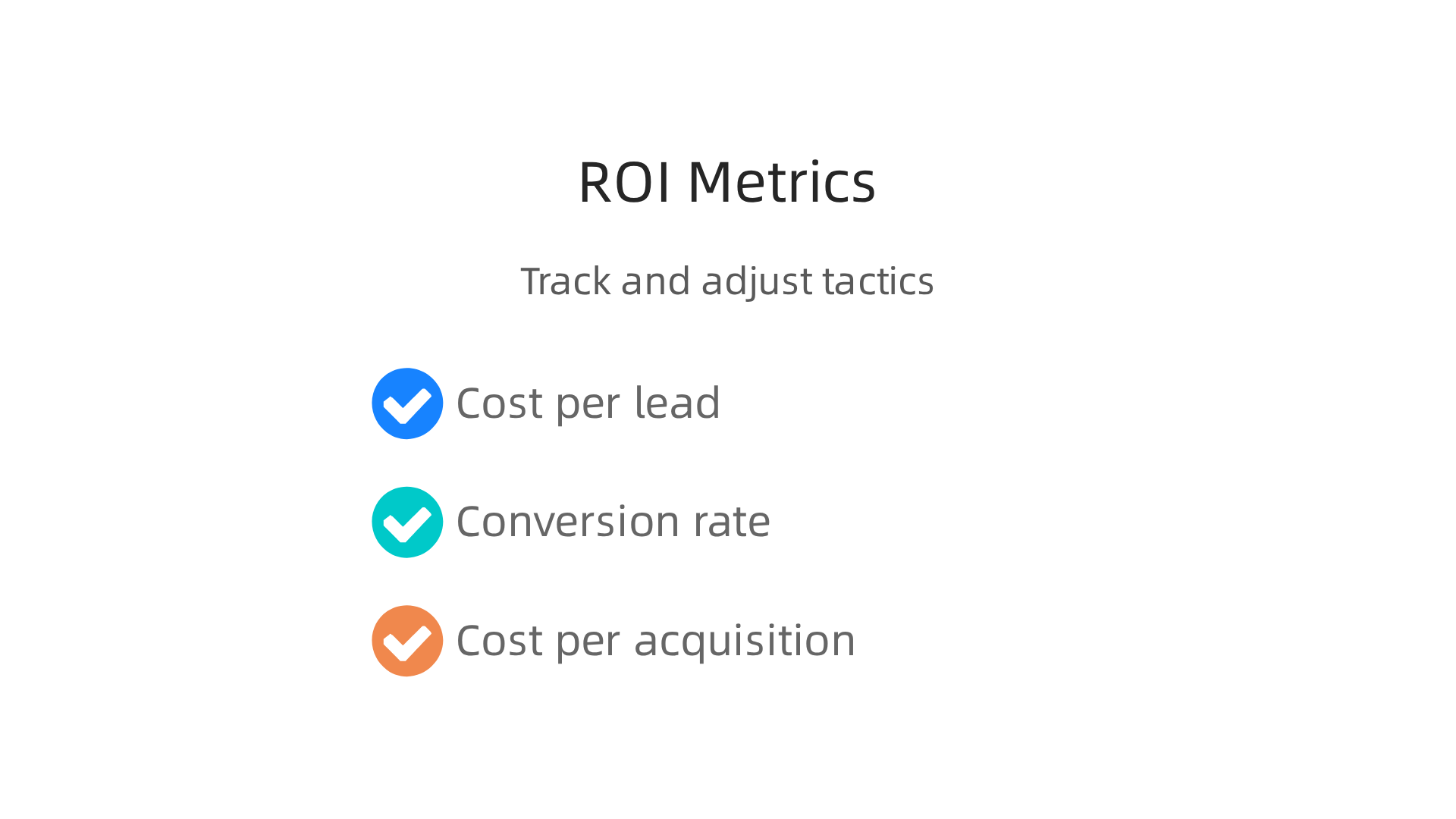
- Cost per lead – Total ad spend divided by number of leads
- Conversion rate – Number of sales divided by number of leads
- Cost per acquisition – Total marketing spend divided by number of closed deals
Once you have these numbers, you adjust. If cost per lead is too high, change your targeting. If conversion rate is low, improve your follow-up process. If cost per acquisition is eating your profit, shift budget to higher performing channels.
A good got to market plan is not a one-time document. It is a living plan that changes based on real data. For more on how to use performance data to refine your approach, check out data-driven insights for Dubai investors.
And if you want to make sure your marketing go to market plan is set up for real results, you can get a FREE Dubai Real Estate Consultation. A quick conversation helps you spot blind spots and build a smarter strategy.
Navigating Legal and Regulatory Considerations for Your GTM
You have a solid marketing go to market plan with clear numbers and tracking. But before you launch any campaign in Dubai, you must make sure it follows the law.

Skipping this step can cost you fines, ad bans, or worse.
Dubai’s Real Estate Regulatory Agency (RERA) keeps a tight grip on off-plan sales and marketing. Any developer or agent who wants to advertise an off-plan project must first get a valid permit from RERA. This includes a No Objection Certificate (NOC) and a properly set up escrow account. The money buyers pay goes into that account and can only be used to build the project. You can learn more about how RERA protects off-plan property buyers to see why this matters.
Your advertising must also be honest. You cannot promise high returns or special payment plans that do not exist. Every ad needs a valid Trakheesi permit, whether it runs on social media, property portals, or billboards. Breaking these rules leads to fines and account restrictions.
Foreign ownership is another big piece of the puzzle. Not every area in Dubai is open to foreign buyers. Freehold zones like Dubai Marina, Jumeirah Lakes Towers, and parts of Dubai Land are available. But you need to check the specific rules for each project before you target international investors. For a full breakdown, check out this guide on freehold property in Dubai for foreign investors.
Building a got to market plan without checking these legal details is a risk you do not want to take. A few hours spent on compliance upfront saves you from expensive mistakes later.
Summary
This article explains why a structured go‑to‑market (GTM) plan is essential for launching and selling Dubai real estate in 2026, and it walks you through a practical, data‑driven approach to build one. It covers Phase 1 research—how to analyze city and micro‑market trends, study competitors, and build clear buyer personas—then shows how to translate those insights into a focused UVP and tailored messaging for different investor types. You’ll learn how to choose the right online and offline channels, when to use virtual tours, and how to budget across pre‑launch, launch and post‑launch phases. The guide also explains how to set realistic timelines, KPIs (cost per lead, conversion rate, cost per acquisition), and how to adapt tactics based on performance. Finally, it highlights critical legal and RERA requirements to avoid fines or marketing bans. After reading, you’ll be able to draft a practical GTM plan tied to milestones, channels, and measurable outcomes so your project reaches the right buyers at the right time.