Introduction — Why understanding house price in Dubai matters for investors
Dubai is a truly exciting place, especially when you think about buying property. Many people from all over the world see it as a great spot for "investment in Dubai real estate". But here’s the thing: understanding the real "house price in Dubai" can be a bit like trying to catch smoke. Prices move up and down quickly, and it’s not always clear how they are decided.
For example, while the Dubai residential sales price index went up by 9.03% over the year, it also saw a small dip of 0.32% month-over-month in March 2026, and in June 2026, prices continued to ease, hitting their lowest point since mid-2025 UAE Residential Property Price Report 2026 March. This shows how fast things can change. Because of these quick changes and sometimes unclear pricing, it can be hard for investors to really know the true value and make the best choices. This makes a clear "dubai real estate valuation" very important.
When you’re thinking about buying property in Dubai, you need to know more than just the listing price. There are other important costs that add up. These can affect how much money you actually make from your investment. Without clear information, it’s easy to feel lost and worried about your money.
This guide is here to help you. We will walk you through how "house price in Dubai" is figured out.
You will learn about the big costs you need to plan for and how different kinds of investors can make smart moves. We will share clear, data-driven facts so you can make confident decisions. If you want to dive deeper into the market, you can explore our dubai real estate price 2026 data-backed investment guide.
Ready to make your move or just have some questions?
FREE Dubai Real Estate Consultation
The house price in Dubai is not just one number; it changes a lot depending on what kind of property you are looking at and where it is located. Knowing these differences is key for smart "investment in Dubai real estate."

Let’s break down typical prices by property type and neighborhood in 2026.
Understanding Price by Property Type
In Dubai, you will mainly find apartments, townhouses, and villas. Each type has its own price range.
- Apartments: These are the most common type of home. In the first three months of 2026, the average price for apartments across the city was about AED 1,872 per square foot [Dubai Residential Market Review]. This can change a lot. For example, a luxury apartment in a fancy area will cost much more per square foot than one further away from the city center.
- Villas: These are larger homes, often with private gardens. Early in 2026, the middle price for villas was around AED 1,468 per square foot [Dubai Property Prices in 2026: Complete Analysis of … – DXB Analytics]. Villas can offer more space and privacy, which many families look for. You can find out more about these spacious options in our guide to Property Finder Villas for Sale in Dubai 2026.

- Townhouses: These are homes that are usually smaller than villas but bigger than apartments, often sharing walls with neighbors in a row. They can be a good middle ground for people wanting more space than an apartment but not a full villa. If you are interested in these, our guide on Why 3-Bedroom Townhouses for Sale in Dubai 2026 Are a Top Investment has useful tips.
How Location Changes the Price
Where a property is located makes a huge difference to its "dubai real estate valuation." We call this "micro-location." Think about how close a home is to important places, nice views, or transport.
- Prime Areas: Some areas are known for being very fancy or having great views. For example, in the first part of 2026, areas like Palm Jumeirah had prices around AED 3,511 per square foot. Jumeirah was also high at about AED 3,175 per square foot. Even Downtown Dubai and Business Bay had high prices, around AED 2,959 and AED 2,211 per square foot, respectively [Dubai Real Estate Market Report 2026: Q1 Data & Outlook]. These areas are often close to the beach, major attractions, or business hubs.
- Connectivity and Amenities: Properties near metro stations, big shopping malls, or good schools often have higher prices. People want to live where things are easy to get to.
- Community Features: The specific community a property is in matters too. Some communities offer private beaches, parks, or special clubs, which adds to the value. This is especially true for those looking into Luxury Real Estate Dubai 2026.
So, when looking at the "house price in Dubai," remember it’s not just the size of the property but also its exact spot that plays a big part in its cost.
Knowing how much a home costs in Dubai today is useful, but it’s even smarter to understand how prices have changed over time. The "house price in Dubai" doesn’t just go up in a straight line; it moves in cycles, like waves. Looking at these past ups and downs can help us understand what might happen next.
Looking Back at Dubai’s Price Changes
Dubai’s property market has seen big changes over the years. For example, since 2021, average property prices have mostly gone up without stopping [Dubai property prices fall for second consecutive month …]. This shows a strong period of growth. However, there have been times when prices cooled down or even dropped.
A good example of growth can be seen in the Dubai City Index, which tracks property values. It hit a new high in April 2026, reaching AED 1,683 per square foot, much higher than AED 716 per square foot in January 2008 [Dubai Residential Hits Record High in April 2026 – LinkedIn]. This long-term view helps in understanding the overall strength of "investment in Dubai real estate." Even with this growth, there have been small dips. For example, residential sales prices in Dubai saw a slight drop of 0.32% in one month earlier in 2026, though they were still up over the whole year by 9.03% [UAE Residential Property Price Report 2026 March].
What we learn from these cycles is that while there can be slowdowns, the market in Dubai has often recovered well.
Signs That Show Market Changes
It’s helpful to look for clues that tell us when the market might be turning. These are called "leading indicators."
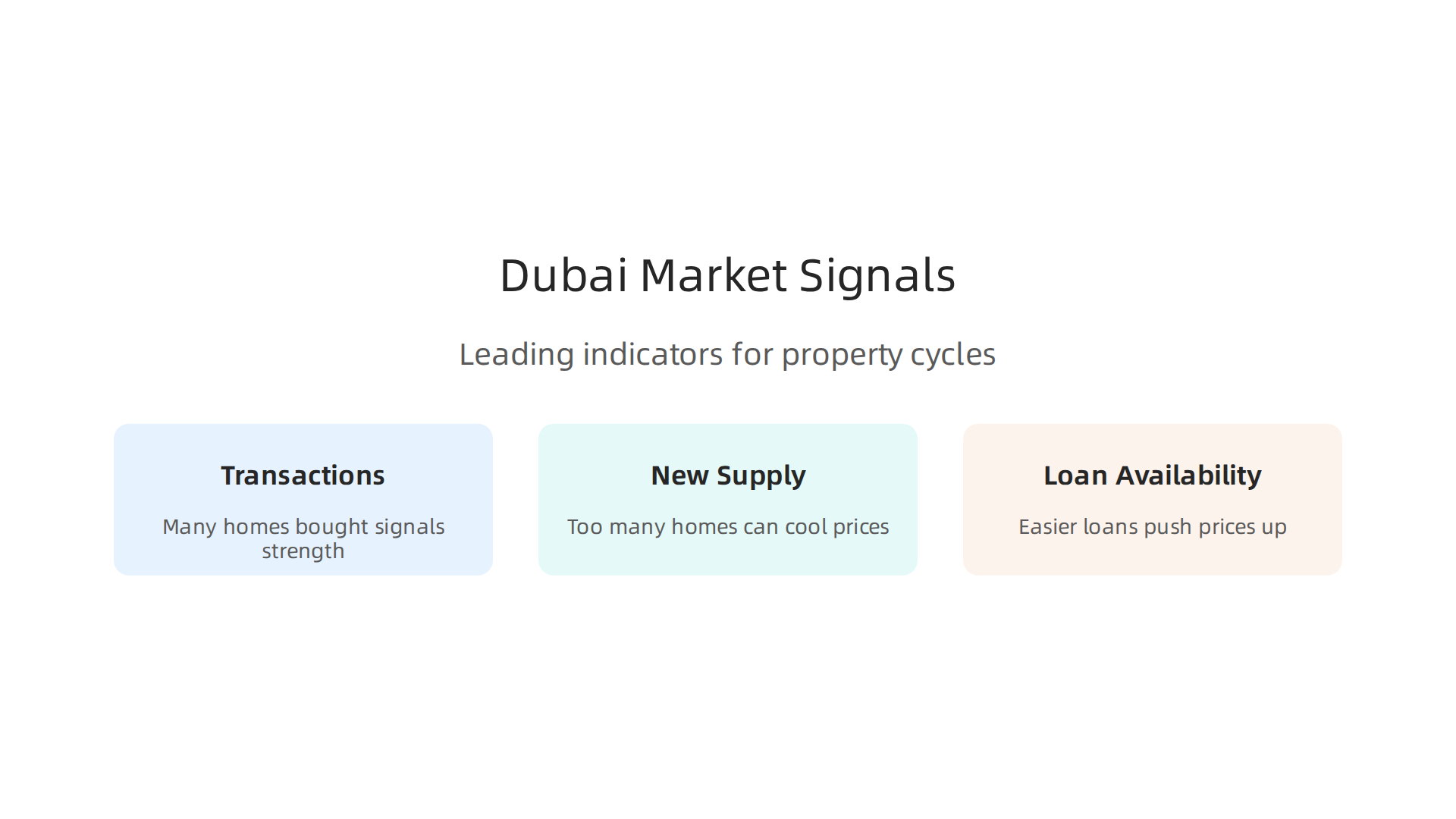
- How many homes are bought and sold: If many homes are being bought, it usually means the market is strong. If fewer homes are selling, it could be a sign that prices might slow down or drop soon. For example, recent data for the first three months of 2026 showed very high transaction numbers, indicating a lively market [Dubai Real Estate Market Data 2026].
- New homes being built: When many new homes are being built and put on the market, it can sometimes mean there will be too many homes for sale. This can cause prices to cool off.
- Money for home loans (mortgage policy): How easy or hard it is to get a home loan can also affect prices. If banks make it easier to borrow money, more people might buy homes, pushing prices up. If it becomes harder, fewer people might buy, and prices could slow down.
Understanding these signals can help with your "Dubai real estate valuation" and guide your choices. Keeping an eye on reports, like the Dubai Real Estate Market Report — June 2026, can give you the latest information.
Being informed about these historical trends and market signals is a smart move for anyone looking to invest. If you want to know more about how to make smart choices, check out our guide on the Dubai real estate investment 2026 your toolkit for data backed decisions.
If you are thinking about buying, selling, or investing and need some expert guidance, consider connecting with a specialist.
Ready to explore your options or need personalized advice for your property goals in Dubai? FREE Dubai Real Estate Consultation.
When we talk about the "house price in Dubai," it’s not just one number. Many things work together to set the cost of a home. Some of these things you can see right away, like where the house is, and some are bigger market forces.

Knowing these helps you understand the true value of an "investment in Dubai real estate."
Location Is King
Just like in many places, where a home sits in Dubai is a huge factor for its price. Some areas are simply more wanted than others. For example, homes near the Dubai Metro stations often rent out quicker because it’s easy to get around [Property Price Forecasts Dubai (2026)]. This makes them more valuable. Places that are close to jobs, good schools, and shops also attract more people, which pushes prices up [Dubai Communities With the Strongest Price Growth in 2026].
Also, certain types of communities are more popular. Family-friendly areas with villas, like Dubai Hills Estate, are seeing strong demand because of their green spaces and schools [Dubai Real Estate Forecast 2026]. Other prime spots like Palm Jumeirah and Downtown Dubai also command higher prices because they are special and don’t have a lot of new homes being built [Dubai Real Estate Market Report: Q2 2026 | Idigov Group]. This community-by-community look helps in understanding the different prices for a home. For a deeper dive, you can read more about Investing in Dubai Hills Property.
Developer’s Name and What the Home Offers
The company that builds the home also plays a big role. A developer with a good name for building quality homes and finishing projects on time can often charge more.
What the home offers matters too.
- Size and Type: A large villa will cost more than a small apartment. Villas and townhouses, for example, are expected to see bigger price increases than apartments in 2026 [Property Price Forecast for Q2 2026 in Dubai: Which Areas …].
- Finishes: The quality of the floors, kitchen, and bathrooms can change the price a lot. High-end, luxury finishes cost more.
- Amenities: Things like a swimming pool, gym, or a view of the city or sea can add extra value.
Even how you pay for the home can affect the deal you get. Some developers offer payment plans where you might pay a smaller amount upfront and the rest over time. This can make a home more attractive, even if the total "house price in Dubai" is similar to another.
Big Picture Factors
Beyond the home itself, larger trends also impact "dubai real estate valuation":
- More People Moving In: Dubai’s population keeps growing. More people means more demand for homes, which tends to make prices go up [Dubai Real Estate Prices 2026: Latest Market Data].
- Government Plans: Programs like the Golden Visa make it easier for people to live in Dubai long-term. This encourages more foreign buyers and investors, adding to the demand for homes [Dubai Property Prices 2026: Trends and Market Insights].
- Interest Rates: When it costs more to borrow money for a home loan, some people might put off buying. When rates are lower, more people might buy, which can push prices up.
All these pieces, from the exact spot of a home to bigger city changes, help shape the "house price in Dubai" and how smart your "investment in Dubai real estate" might be.
When thinking about your "investment in Dubai real estate," one big choice is whether to buy an off-plan property or a ready home.
Each option has its own "house price in Dubai" and ways of paying.
Off‑plan vs Ready (Completed) Properties: Price and Risks
Off-Plan Properties
These are homes you buy directly from a builder before they are fully built. Think of it like buying a car model that isn’t made yet.
- Lower Starting Price: Off-plan properties often cost less at the start. In 2026, many off-plan homes are typically 15% to 30% cheaper than similar homes that are already built in the same area [Off-Plan vs. Ready Property in Dubai 2026 – Behnia Tavassoli]. This can make them seem like a good deal for your "investment in Dubai real estate."
- Payment Plans: Builders often let you pay for off-plan homes in small parts over time. You might pay a little bit upfront, then more as the building gets done, and the final payment when it’s ready. This helps spread out the cost.
- Potential for Value Growth: If the area becomes more popular while the home is being built, its value can go up before you even move in.
Risks with Off-Plan
However, buying off-plan also has its risks.
- Delays: The building might take longer to finish than planned. This means you have to wait longer to move in or start renting it out.
- Changes to Quality: Sometimes, the finished home might not look exactly like the pictures or have the same quality of materials you expected.
- Developer Issues: Though rare in Dubai, a developer could face problems. Dubai has rules in place to protect buyers, like escrow accounts where your money is held safely [Dubai Off-Plan vs Ready Properties in 2026].
Ready Properties
These are homes that are already built and ready for you to move into or rent out right away.
- Immediate Use: You can get the keys and start using the property or earning rental income without waiting. This is great if you want to see an immediate return on your "investment in Dubai real estate."
- What You See Is What You Get: You can walk through the home and see exactly what you are buying. No surprises about the finish or how it looks.
- Less Risk: There are no worries about construction delays or the builder changing plans.
Costs for Ready Properties
Ready properties usually have a higher initial "house price in Dubai" because they are complete and ready. When you buy a ready property, you’ll also need to pay some extra fees. For example, the Dubai Land Department (DLD) charges a 4% transfer fee on the purchase price. There are also smaller fees for things like administration and trustee services [Dubai Property Transfer Fees 2026 | DLD & Agent Costs]. In total, buyer closing costs in Dubai often range from 5% to 9% of the property’s price in 2026 [Property Taxes, Fees and Costs in Dubai (2026)].
To learn more about finding properties you can move into right away, check out this guide on Ready to Move Property in Dubai.
Deciding between off-plan and ready homes depends on your goals. Do you want a lower entry price and potential for growth over time, even with some risks? Or do you prefer certainty and immediate use, even if it means a higher upfront "house price in Dubai"? This choice is a big part of how you value your "dubai real estate valuation."
If you’re still weighing your options or need expert guidance on your next property move in Dubai, we’re here to help.
Connect with Ayaz Salman for FREE Dubai Real Estate Consultation.When thinking about your "investment in Dubai real estate," one big choice is whether to buy an off-plan property or a ready home. Each option has its own "house price in Dubai" and ways of paying.
Off‑plan vs Ready (Completed) Properties: Price and Risks
Off-Plan Properties
These are homes you buy directly from a builder before they are fully built. Think of it like buying a car model that isn’t made yet.
- Lower Starting Price: Off-plan properties often cost less at the start. In 2026, many off-plan homes are typically 15% to 30% cheaper than similar homes that are already built in the same area [Off-Plan vs. Ready Property in Dubai 2026 – Behnia Tavassoli]. This can make them seem like a good deal for your "investment in Dubai real estate."
- Payment Plans: Builders often let you pay for off-plan homes in small parts over time. You might pay a little bit upfront, then more as the building gets done, and the final payment when it’s ready. This helps spread out the cost.
- Potential for Value Growth: If the area becomes more popular while the home is being built, its value can go up before you even move in.
Risks with Off-Plan
However, buying off-plan also has its risks.
- Delays: The building might take longer to finish than planned. This means you have to wait longer to move in or start renting it out.
- Changes to Quality: Sometimes, the finished home might not look exactly like the pictures or have the same quality of materials you expected.
- Developer Issues: Though rare in Dubai, a developer could face problems. Dubai has rules in place to protect buyers, like escrow accounts where your money is held safely [Dubai Off-Plan vs Ready Properties in 2026].
Ready Properties
These are homes that are already built and ready for you to move into or rent out right away.
- Immediate Use: You can get the keys and start using the property or earning rental income without waiting. This is great if you want to see an immediate return on your "investment in Dubai real estate."
- What You See Is What You Get: You can walk through the home and see exactly what you are buying. No surprises about the finish or how it looks.
- Less Risk: There are no worries about construction delays or the builder changing plans.
Costs for Ready Properties
Ready properties usually have a higher initial "house price in Dubai" because they are complete and ready. When you buy a ready property, you’ll also need to pay some extra fees. For example, the Dubai Land Department (DLD) charges a 4% transfer fee on the purchase price. There are also smaller fees for things like administration and trustee services [Dubai Property Transfer Fees 2026 | DLD & Agent Costs]. In total, buyer closing costs in Dubai often range from 5% to 9% of the property’s price in 2026 [Property Taxes, Fees and Costs in Dubai (2026)].
To learn more about finding properties you can move into right away, check out this guide on Ready to Move Property in Dubai.
Deciding between off-plan and ready homes depends on your goals. Do you want a lower entry price and potential for growth over time, even with some risks? Or do you prefer certainty and immediate use, even if it means a higher upfront "house price in Dubai"? This choice is a big part of how you value your "dubai real estate valuation."
If you’re still weighing your options or need expert guidance on your next property move in Dubai, we’re here to help.
Connect with Ayaz Salman for FREE Dubai Real Estate Consultation.
After you pick between an off-plan or ready home, the next big step is figuring out how much money your property will actually make for you. This means looking at what’s called "rental yield" and the "total cost of ownership," or TCO. These ideas help you understand the true value of your "investment in Dubai real estate" beyond just the initial "house price in Dubai."
Assessing Rental Yield and Total Cost of Ownership (TCO)
When you invest in property, you want to know how much profit you can expect from rent. This is where rental yield comes in. There are two main types: gross yield and net yield.
Gross Rental Yield: The Simple View
Gross rental yield is the easiest way to look at how much rent your property brings in compared to its purchase price. It’s found by dividing the total money you get from rent in a year by the price you paid for the property, then multiplying by 100 to get a percentage [Average Rental Yields in Dubai – 2026 Market Insights].
For example, if a home costs AED 1,000,000 and earns AED 80,000 in rent each year, the gross yield is 8%. This looks good, right? But it doesn’t tell the whole story.
Net Rental Yield: The Real Picture
Net rental yield is much more important for your "dubai real estate valuation." It shows you the real profit you make after paying for all the running costs of the property. Think of it like this: your car might earn you money if you use it for a taxi service, but you also have to pay for gas, repairs, and insurance. The net yield takes these costs away.
Here are the common costs that lower your rental income:
- Service Charges: These are yearly fees you pay to keep the building and common areas nice, like pools, gyms, and lobbies. In 2026, these can be a big part of your costs, especially for luxury places, sometimes eating up 20% to 40% of the rent [Dubai Rental Yields by Community 2026 | MRK Real Estate].
- Maintenance: Even new homes need small repairs or upkeep. It’s smart to save some money for this each year.
- Vacancy Allowance: Sometimes your property might sit empty between renters. You should plan for a small period where you don’t earn rent, maybe 5% to 10% of the year [Dubai Rental Yield Calculator (Gross & Net) — 2026 | REMAP].
- Property Management Fees: If you hire someone to manage your property and find renters, they will charge a fee, usually 5% to 8% of the annual rent [Dubai Real Estate ROI 2026 — What 8-10% Actually Means After …].
- Insurance: Protecting your property with insurance is a wise choice.
How to Calculate Realistic Investor Yields
To get a clear idea of your net rental yield, follow these steps:
- Find Your Annual Rent: This is the total rent you expect to get in a year.
- List All Annual Costs: Add up all the expenses mentioned above: service charges, maintenance, possible vacancy, and management fees.
- Subtract Costs from Rent: Take your total annual costs away from your total annual rent. This gives you your net annual income.
- Calculate Net Yield: Divide your net annual income by the full purchase price of your property (including any initial buying fees). Then multiply by 100 to get the percentage.
The formula looks like this:
Net Rental Yield (%) = [(Annual Rent - Annual Expenses) / Property Purchase Price] x 100 [Dubai Rental Yield Calculator: How to Calculate ROI 2026]
For a deeper dive into how to really calculate your returns and avoid common mistakes, you can watch this video on How to Calculate REAL ROI on Dubai Property.
Understanding your net yield is key to making a smart "investment in Dubai real estate." A net yield of 5% or more is often seen as a good return after all costs are paid [Dubai Rental Yield Calculator: How to Calculate ROI 2026]. By doing these calculations, you can truly assess your potential profit and make informed choices in the "Dubai property market 2026." If you want to learn more about the overall market trends, check out our guide on Dubai real estate price.
Understanding your net yield is key to making a smart "investment in Dubai real estate." After you know how much profit a property might make, the next step is to choose the right place for your money. Different neighborhoods in Dubai offer different things. Some are great if you want your property’s value to go up a lot, while others are better for getting steady rent checks.
Top neighborhoods by investor goal — capital growth vs steady rental yield
When you invest in Dubai real estate, it’s like choosing between a fast-growing plant and one that gives fruit all year. Your choice depends on what you want to achieve. Do you want the "house price in Dubai" to climb fast, or do you prefer a steady stream of rental income?

Neighborhoods for Capital Growth (Value Going Up)
If you hope to sell your property later for much more than you paid for it, you’re looking for capital growth. These areas often see quick increases in property values. In 2026, some top spots for this are:
- Luxury and Prime Areas: Places like Palm Jumeirah, Emirates Hills, and Downtown Dubai are known for high-end properties. These areas have fewer new homes being built, which helps their prices go up [Dubai Real Estate Market Report: Q2 2026]. For example, Emirates Hills saw a big jump in villa prices in early 2026 [Dubai Real Estate Market Q1 2026 – Key Trends & Data].
- Emerging Areas with New Infrastructure: Areas getting new roads or Metro lines often see their property values rise. The upcoming Dubai Metro Blue Line is expected to boost prices near its new stations [Property Price Forecasts Dubai (2026)]. Areas like Dubai South are good examples of emerging places with high potential.
- Family-Focused Villa Communities: Places that families love, with green spaces and schools, often show strong demand. Dubai Hills Estate is a prime example, continuing to see good price increases [Property Price Forecast for Q2 2026 in Dubai]. Jumeirah Village Circle (JVC) also promises good gains because it’s affordable and close to business centers [Dubai Real Estate Forecast 2026].
These areas are great if you’re thinking about a short-term flip or want to see your asset grow significantly over time. When more people want to live in an area and there are limited homes, the "house price in Dubai" naturally increases [Dubai Communities With the Strongest Price Growth in 2026]. If luxury properties interest you for this kind of growth, our Luxury real estate Dubai 2026 investors definitive guide can offer more insights.
Neighborhoods for Steady Rental Yield (Regular Income)
If your goal is to get consistent rent payments, you’ll look for areas with strong rental demand and good net yields. These neighborhoods might not see explosive price growth, but they offer reliable income, making your "dubai real estate valuation" stable.
Some areas known for solid rental yields in 2026 include:
- Business Bay & Dubai Marina: These central areas are always popular with renters, especially expats who work nearby. They often offer rental yields of 6% to 7% [Dubai Real Estate Price Trends 2026–2027].
- Jumeirah Village Circle (JVC): Besides capital growth potential, JVC also provides good rental yields, making it a favorite for investors looking for a balance.
- International City: This area is known for its affordable properties and can offer attractive rental yields due to high demand for budget-friendly housing.
Dubai properties, in general, offer strong rental yields, often ranging from 5.5% to 8.5%, which is competitive globally [Dubai Property Prices 2026: Trends and Market Insights]. This consistent income helps ensure your investment keeps giving back year after year.
Matching Your Goals to the Right Neighborhood
Your investment style should guide your choice:
- Short-Term Flip (Capital Growth): If you plan to buy and sell quickly, focus on prime or emerging areas with signs of strong future growth. You’ll want to watch for new developments or changes in how people move around the city.
- Long-Term Rental (Steady Yield): If you want a regular income, pick neighborhoods with high rental demand, good transport links, and a steady flow of tenants. Here, the net rental yield is your main concern.
- Hybrid Approach: Some areas, like Dubai Hills Estate or JVC, offer a good mix of both rising values and decent rental income, letting you enjoy both benefits.
Choosing the right neighborhood is a big part of successful "investment in Dubai real estate." It’s not just about the "house price in Dubai," but about how that price will change and how much rent you can realistically earn.
If you’re still weighing your options or need help finding the perfect neighborhood that aligns with your specific investment goals, getting expert advice can make a huge difference.
Connect with Ayaz Salman for Free Consultation
Choosing the right neighborhood is a smart move for your "investment in Dubai real estate." But after you pick the best spot, you need to understand all the money parts that come with buying a property. The listed "house price in Dubai" is just one piece of the puzzle. There are other fees and costs that add up.
Financing, fees, taxes and transaction costs for buyers in Dubai
When you buy property in Dubai, the total amount you pay is more than just the listed "house price in Dubai." You also have to cover different fees and costs. These extra costs can be 5% to 10% of the property’s price in 2026, so it’s good to know about them upfront [Property Taxes, Fees and Costs in Dubai (2026)]. This helps you get a clear picture of your total "dubai real estate valuation."
Here are the main costs you will usually pay as a buyer:
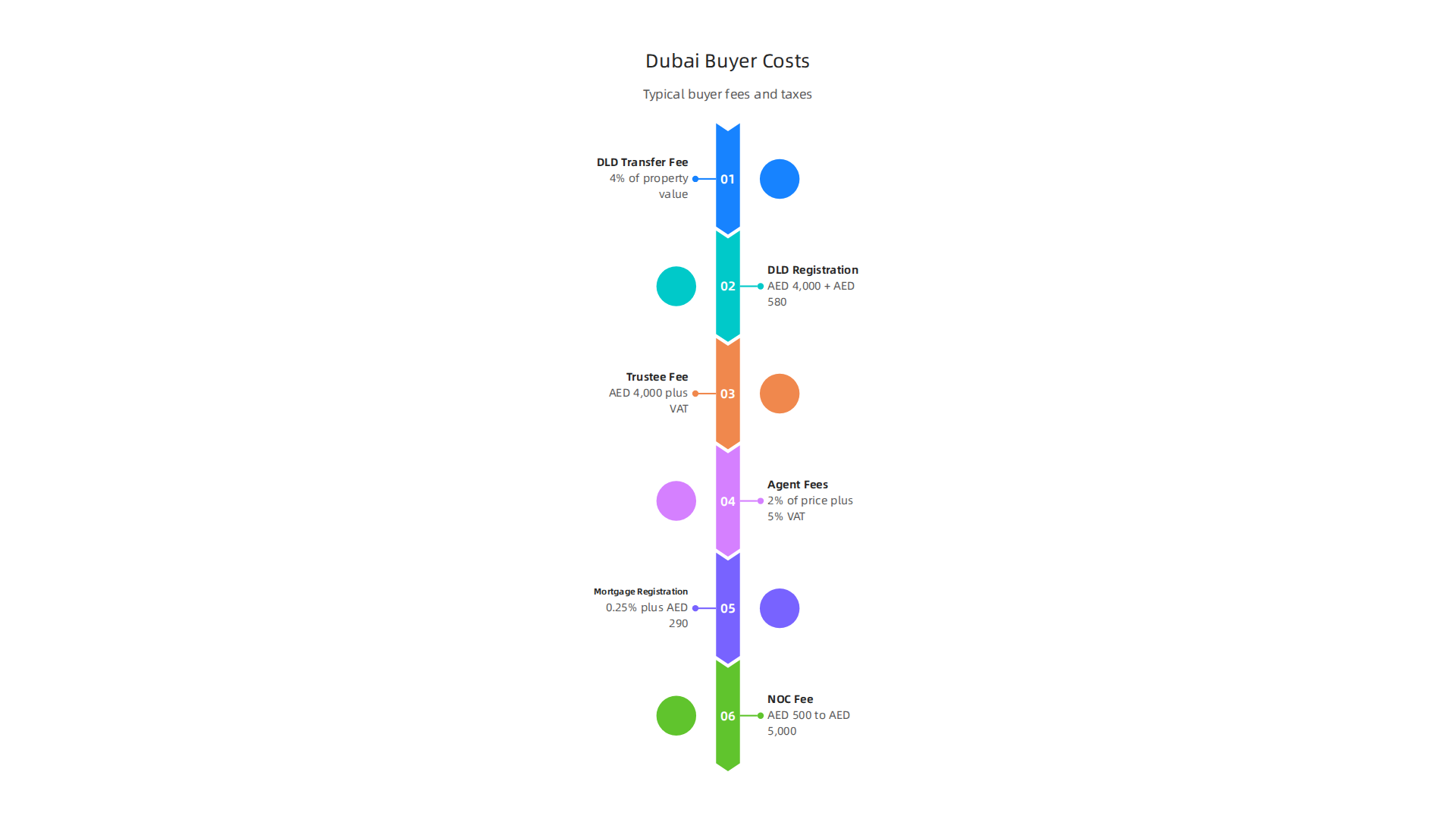
- Dubai Land Department (DLD) Transfer Fee: This is the biggest cost. It’s 4% of the property’s value. While the law says buyers and sellers can split this, often the buyer ends up paying the full 4% [Dubai Property Transfer Fees 2026 | DLD & Agent Costs].
- DLD Admin and Registration Fees: On top of the transfer fee, there are smaller official fees. For properties over AED 500,000, you will pay about AED 4,000 for registration plus an AED 580 admin fee for apartments [The Hidden Costs of Buying Property in Dubai in 2026].
- Trustee Office Fee: When you buy a property, you go through a trustee office. They charge a fee, which is usually AED 4,000 plus VAT for properties costing more than AED 500,000 [Cost of Buying Property in Dubai: A Complete 2026 Guide].
- Real Estate Agent Fees: If you use a real estate agent to help you find and buy property, you’ll typically pay them a fee. This is often 2% of the property price, plus 5% VAT [The REAL Cost of Buying Property in Dubai (2026 Guide)].
- Mortgage Registration Fee: If you get a home loan (mortgage) from a bank in the UAE, you need to register it with the DLD. This fee is 0.25% of your loan amount, plus an extra AED 290 [Every Fee You’ll Pay When Buying Property in Dubai in 2026].
- No Objection Certificate (NOC) Fee: This is a small fee, usually between AED 500 to AED 5,000, that you pay to the property developer to confirm they have no issues with the sale.
Financing Your Dubai Property
Many people, including expats and non-resident investors, can get loans from banks in Dubai to help buy property. However, it’s important to know that these bank loans usually only cover the "house price in Dubai." As of 2026, you must pay all the extra transaction fees like DLD fees and agent fees out of your own pocket upfront. Banks cannot include these costs in your mortgage loan [Dubai Property Buying Costs | Complete Fee Breakdown …].
The terms of your loan, like the interest rate and how long you have to pay it back, will affect the real total cost of your property over time. So, it’s wise to look at different loan options carefully. Understanding these costs is key to smart "investment in Dubai real estate." For more details on buying property as a foreigner, check out our how to buy properties in Dubai in 2026. Knowing all the fees and how financing works will help you truly understand the full cost and potential returns of your investment. It helps you accurately assess the "dubai real estate valuation" and ensures there are no surprises.
Summary
This guide explains how the