
Introduction: Navigating Dubai’s Property Market with Confidence
Picture this. You have been dreaming about owning a place in Dubai.

Maybe a sleek apartment with a view of the skyline. Or a villa near the beach. Or even a plot for sale in Dubai where you can build something from scratch.
But every time you start researching, the information feels endless. Conflicting advice. Complicated rules. And that nagging worry about making a costly mistake.
You are not alone.
Dubai’s real estate market offers incredible opportunities. Rental yields here often beat most global cities. Property values have shown strong growth over the years. And the best properties to invest in Dubai can deliver steady returns.
Yet here is the reality. Many foreign investors jump in without a clear plan. They get drawn by flashy listings and miss the fine print. Some end up buying in areas where foreign ownership is restricted. Others skip proper due diligence on developers. The result? Expensive lessons that could have been avoided.
The truth is that many of the common mistakes buyers face come from a lack of trusted guidance. As one expert analysis on common Dubai property investment mistakes foreign buyers must avoid points out, issues like working with unlicensed agents or overlooking legal checks can turn a promising deal into a regretful one.
So how do you buy property in Dubai the right way?
You need a reliable roadmap. One that covers the legal steps. The financial requirements. The practical decisions that protect your money and your future.
That is exactly what this guide delivers.
We have gathered the latest 2026 data, expert insights, and real-world advice to help you move forward with confidence. Whether you are looking at luxury property Dubai has to offer or considering a sale real estate Dubai opportunity, this guide walks you through each stage.
And if you want personalized help from someone who knows the local market inside out, you can get a FREE Dubai Real Estate Consultation to ask your specific questions.
For a deeper look at the legal side for international buyers, check out this guide on buying property in Dubai as a foreigner.
Let us start with what matters most. The prep work before you even begin browsing listings.
Understanding the Dubai Property Market in 2026
Before you start looking at listings, you need to understand what is actually happening in the market right now.

Dubai’s property scene moves fast. What worked two years ago may not work today. So let us look at where things stand in 2026.
The numbers tell a strong story. In January 2026 alone, Dubai recorded AED 73 billion in total sales value, according to the latest Dubai Real Estate Market Report. That is a huge number. And it shows that both local and foreign buyers are still actively investing.
Prices have been climbing steadily. Citywide residential capital values are expected to achieve a sustainable 10% growth in 2026, according to the ValuStrat Dubai Real Estate Market Outlook. That growth is a bit slower than the boom years, but it is healthier. A slower, steady climb is easier to plan around than a crazy spike.
What does this mean for you? It means there are still great opportunities. But you need to be smart about how to buy properties in Dubai without overpaying.
Rental Yields That Catch Your Eye
One of the biggest reasons people invest in Dubai is the rental income. Dubai offers some of the highest rental yields in the world. Many areas deliver returns between 6% and 10% annually. Compare that to cities like London or New York where yields hover around 3% to 4%. That difference adds up fast.
For income-focused investors, this is the real draw. You are not just hoping the property goes up in value. You are earning cash while you wait.
Three Major Trends Shaping 2026
Three things stand out right now if you are learning how to buy properties in Dubai the right way.
First, off-plan properties are in huge demand. Buyers are snapping up units before they are built. Why? Lower upfront costs and the chance to see big gains by the time construction finishes. The government has tightened rules around off-plan sales, making them safer than in the past.
Second, freehold zones are expanding. More areas are opening up to full foreign ownership. This means you have more choices when looking for a freehold property in Dubai. You no longer have to stick to just a handful of districts.
Third, regulations keep improving. The Dubai Land Department and the Real Estate Regulatory Authority (RERA) have introduced stronger protections. Escrow accounts for off-plan deposits. Better transparency around developer track records. These changes make the market safer for everyone.
The Big Picture for You
The Dubai property market in 2026 is not a wild west anymore. It is maturing. Yes, there was a short dip in transaction volumes in early March 2026 (a 37% drop year-on-year in the first 12 days), according to a Reuters report on early signs of weakness. But that appears to be a temporary blip, not a crash. Long-term forecasts still point to 3.5% to 4.5% annual appreciation over the next decade, as noted in the Dubai property price forecast analysis.
So the market is healthy. You just need to know where to look and how to buy smart.
If you want a deeper look at the overall landscape, check out this 2026 guide on Dubai property market trends and guide for more data.
Now that you understand the big picture, let us move into the prep work. What you need to have ready before you even start viewing properties.
Legal Framework for Foreign Buyers: Ownership Rules & Freehold Areas
Now that you have a feel for the market, let us talk about the legal side. Many people worry that buying property in Dubai as a foreigner is complicated. The truth is simpler than you think.
Freehold vs. Leasehold: What Is the Difference?
Two main ownership types exist for foreign buyers. Understanding them is key to knowing how to buy properties in Dubai the right way.
Freehold ownership means you own the property and the land it sits on. You can hold it forever. You can sell it, rent it, or pass it to your kids. No time limit. No expiry date. Freehold zones in Dubai include popular areas like Dubai Marina, JLT, Downtown Dubai, Arabian Ranches, and Palm Jumeirah. There are over 40 designated freehold areas across the city, as explained in this detailed guide on buying property in Dubai as a foreigner in 2026.
Leasehold ownership is different. You get the right to use the property for a set period. Usually 99 years. You do not own the land. But you can live there, rent it out, or sell the lease to someone else. Leasehold is common in areas where freehold is not available.
Which one should you pick? If you want full control and long-term investment, go freehold. If you find a great property in a leasehold area and the price is right, it can still be a smart move.
New Rules in 2026 That Help You
The Dubai government keeps improving protections for buyers. Here are the biggest updates this year.
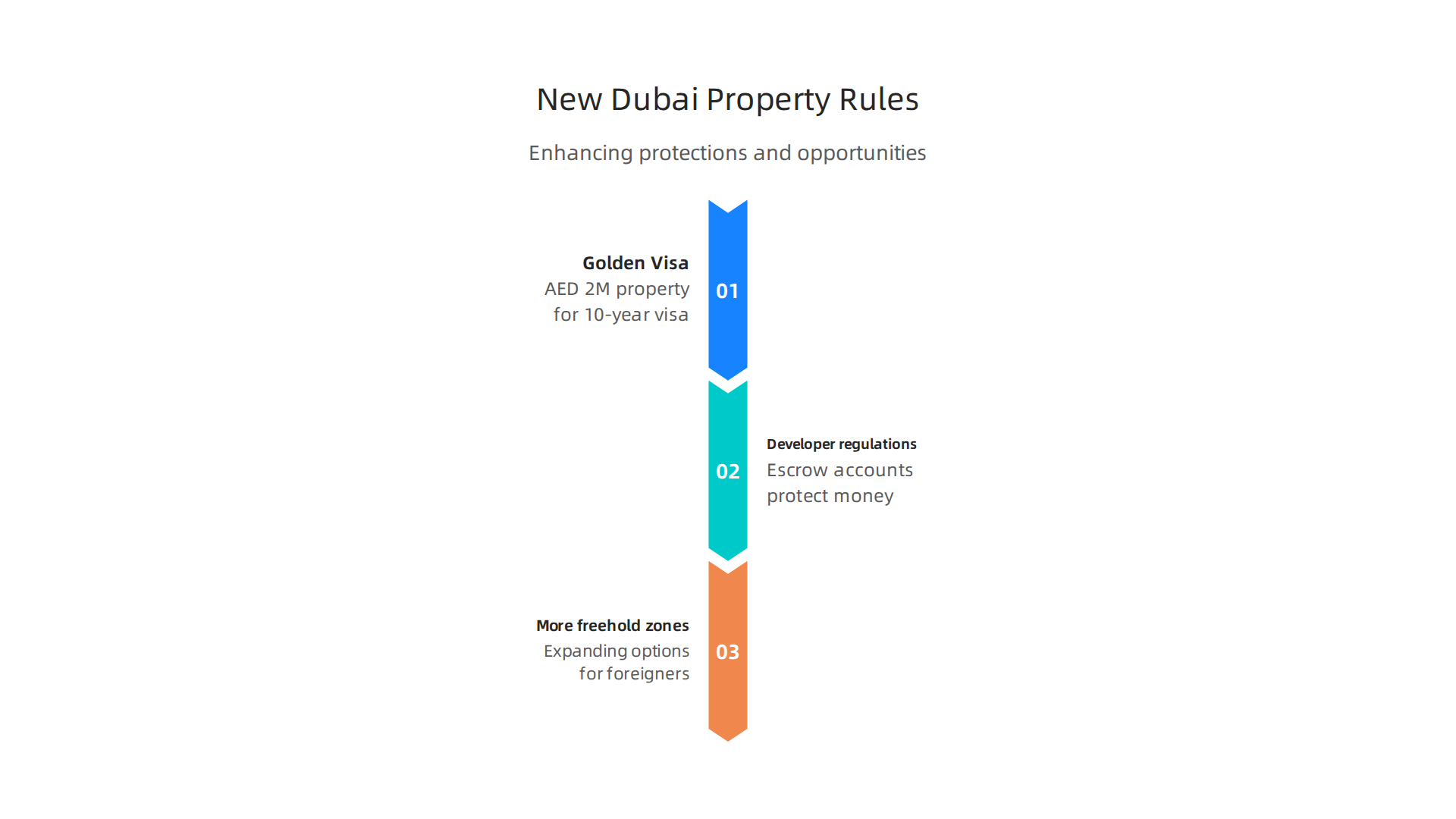
Golden Visa for property investors. If you buy a property worth AED 2 million or more, you can get a 10-year renewable residency visa. That is a game changer. No need for a local sponsor. You can live, work, and study in the UAE. Your family can join you too. And you can stay outside the UAE for as long as you want without losing your visa.
Stronger developer regulations. RERA now requires developers to register all off-plan sales in an escrow account. Your money stays protected until the project is complete. If the developer delays or fails, you get your money back. That makes off-plan buying much safer than it used to be.
More freehold zones opening up. The list of areas where foreigners can buy keeps growing. In 2026, new communities are being added. This gives you more options when looking for the best properties to invest in Dubai.
What You Need Before You Buy
Here is a quick checklist before you start:
- Valid passport
- Proof of income or bank statements
- No objection letter from your current bank if taking a mortgage
- A UAE residency visa (not required but helps with mortgages)
- A trusted real estate agent registered with RERA
The process is straightforward. The government has made it easy for foreign investors. You just need the right guidance. For a full breakdown of the legal steps, check out this resource on Dubai real estate laws and regulations for 2026.
One Last Thing About Visas
Do not underestimate the Golden Visa. It is not just a perk. It is a major reason people choose Dubai over other markets. You buy one property worth AED 2 million, and you secure a decade of stability for you and your family. That alone makes how to buy properties in Dubai a question worth answering.
If you are ready to take the next step and want expert guidance, you can get a FREE Dubai Real Estate Consultation with Ayaz Salman. No pressure. Just honest advice about what works for your situation.
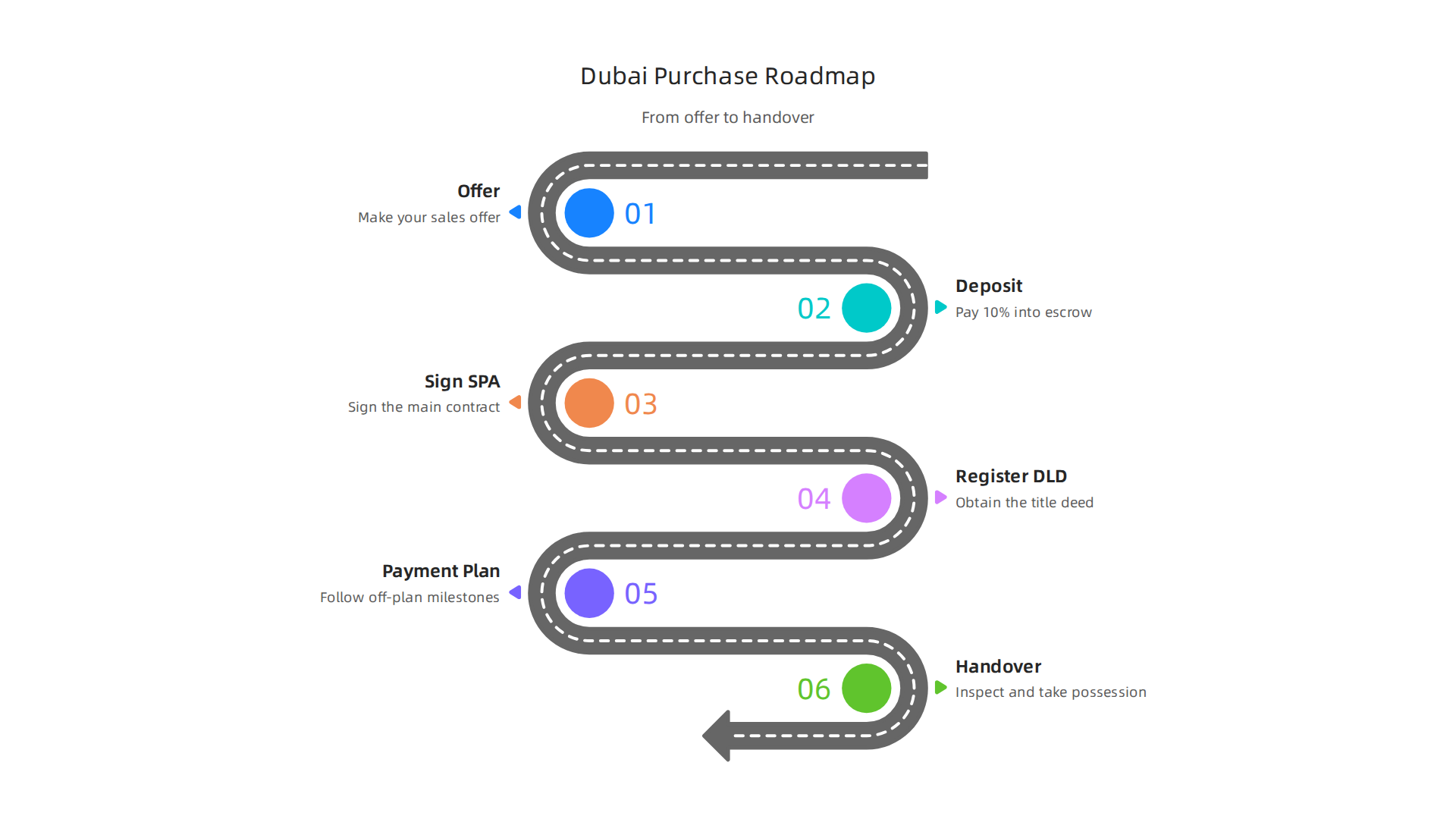
Step‑by‑Step Purchase Process: From Offer to Handover
Now that you understand the legal rules, let us walk through the actual buying process. Many people feel nervous about this part. But when you break it down, how to buy properties in Dubai is really just a series of clear steps.
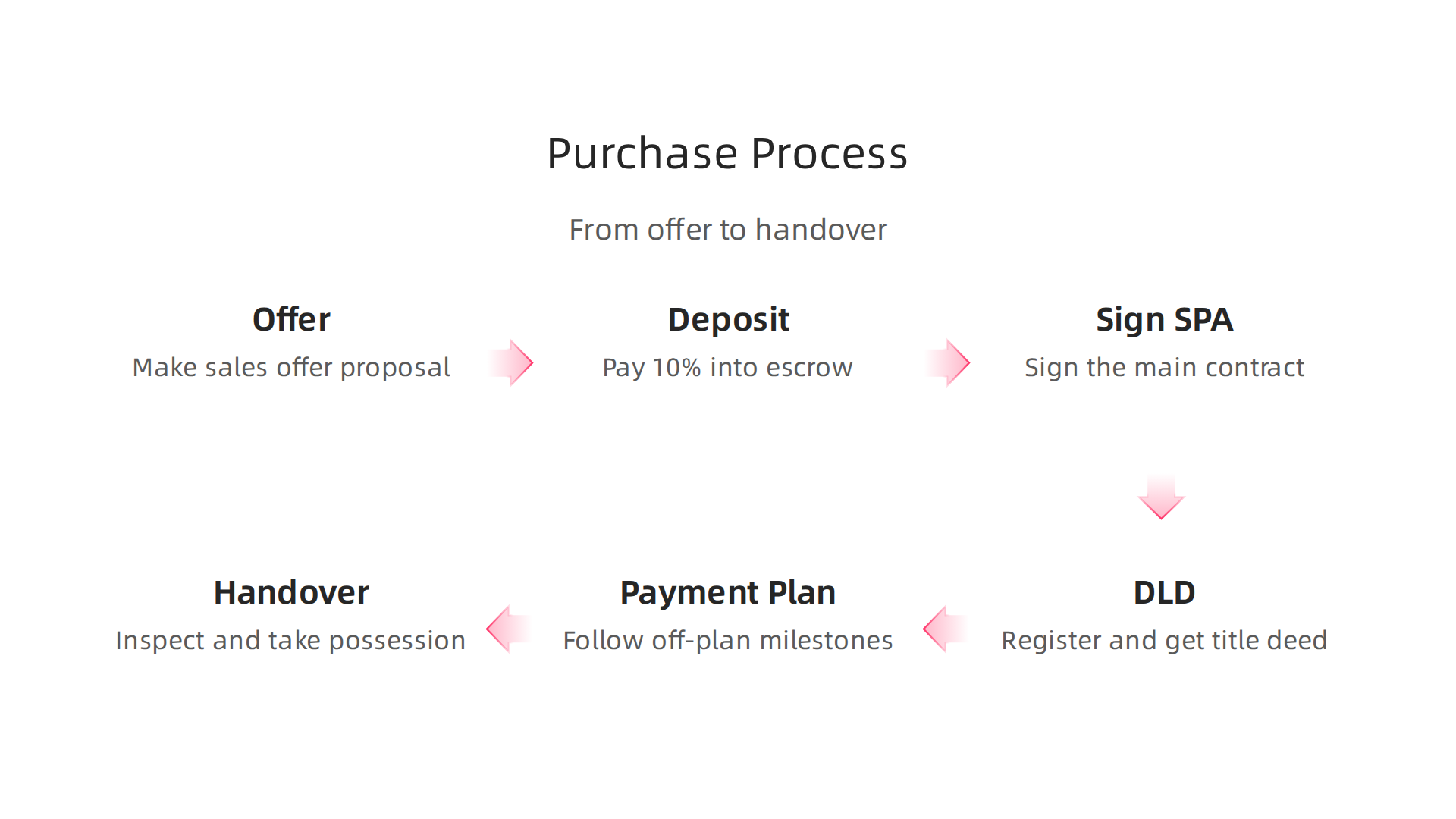
Step 1: Make Your Offer
You find a property you like. Your agent submits a document called a Sales Offer Proposal (SOP). This is not a contract. It is a written offer that shows the price you want to pay and your proposed payment schedule.
The seller can accept, reject, or counter. Once both sides agree, you move to the next step. Do not skip this. The SOP protects you by putting everything in writing.

Step 2: Pay the Deposit
You usually need to pay a deposit right after the offer is accepted. This is typically 10 percent of the price. It shows the seller you are serious. The deposit goes into an escrow account, not directly to the seller. That keeps your money safe until the deal closes.
Missing this deadline is one of the biggest mistakes first-time buyers make. So mark your calendar and have your funds ready.
Step 3: Sign the Sales Purchase Agreement (SPA)
This is the main contract. It spells out everything. The price. The payment plan. The handover date. The penalties for delays. Both you and the seller sign it.
Read every line carefully. Ask your agent or a lawyer to explain anything unclear. Once you sign, you are legally committed. For more detail on the paperwork, check out this resource on real estate ownership rules for foreigners in Dubai and Abu Dhabi.
Step 4: Register with Dubai Land Department (DLD)
After the SPA is signed, you must register the property with the DLD. This step makes the sale official. You pay a registration fee, usually 4 percent of the purchase price plus a small administrative charge.
The DLD issues a title deed in your name. That is your proof of ownership. No one can challenge it.
Step 5: Follow the Payment Plan
If you bought off-plan, your payment plan was already agreed in the SPA. You make payments at set milestones. Construction completion. Foundation laid. Handover.
Stick to the schedule. Missing a payment can lead to penalties or even cancellation of the sale. If you need help managing your investment, a step by step guide to finding property in Dubai can show you how to stay on track.
Step 6: Handover and Take Possession
Once the property is finished, the developer gives you the keys. But do not just walk in. Inspect everything. Check for defects. Make sure all promises from the brochure are delivered.
You have a defects liability period after handover, usually one year. If something breaks, the developer must fix it at no cost to you.
Common Pitfalls to Avoid
Let me save you some headaches.
- Missing deposit deadlines. Set reminders. Have the money ready before you make an offer.
- Unclear payment schedules. Get them in writing. Do not rely on verbal promises.
- Skipping due diligence. Check the developer’s track record. Check RERA registration. Check that the property is in a freehold zone.
- Not reading the SPA closely. Every clause matters. Especially penalty clauses and handover dates.
If you follow these steps and avoid those mistakes, you will find that sale real estate Dubai is a smooth and rewarding experience.
The process is designed to be buyer-friendly. The government has built strong protections. You just need to stay organized and work with people you trust.
Financing Your Dubai Property: Mortgages & Payment Plans for Foreigners
You have found the perfect property and made an offer. Now comes the big question: how do you actually pay for it? If you are not paying cash, you need to understand your financing options. Let me break them down for you.
Can Foreigners Get a Mortgage in Dubai?
Yes. Foreigners can absolutely get a mortgage in Dubai. But the rules are different than for residents. The amount you can borrow depends on your residency status. In 2026, non-residents typically get a loan-to-value (LTV) ratio of 50 to 65 percent. That means you need a down payment of 35 to 50 percent. For example, on a AED 2 million property, you might finance AED 1 million and put down AED 1 million yourself. Check out this detailed Dubai mortgage guide for non-residents in 2026 to see the exact numbers for different property values.
Residents who are salaried in the UAE can often get up to 80 percent financing on properties under AED 5 million. So your down payment is much lower at around 20 percent. If you plan to move to Dubai before buying, that can save you a lot of cash upfront.
Developer Payment Plans vs. Bank Loans
For off-plan properties, you have two main paths.
Developer payment plans are popular. You pay a percentage at booking, then smaller amounts during construction, and the rest at handover. No bank interest. Just a schedule you agree with the developer. This is great if you want to avoid loan paperwork.
Bank loans give you the full amount at once. You buy the property now and repay the bank over years. This works better for ready properties or when you want to own the title deed immediately.
Which is better? If you have the cash flow to follow a payment plan, go with the developer. If you want to lock in ownership and build equity, a bank mortgage is smarter. The choice depends on your personal situation.
2026 Interest Rate Trends
Interest rates in 2026 are holding steady after recent hikes. UAE banks offer competitive rates for non-residents. Some major banks like Emirates NBD and HSBC have dedicated home loan programs for expats. Rates shown on their websites tentatively start around 3.99 percent per annum (reducing). That is still low compared to many other countries.
But rates can change. Your final mortgage rate depends on your profile, the property value, and the loan amount. Always compare offers from at least three banks.
Making the right financing choice is key to a successful investment. If you want personalized guidance on the best mortgage or payment plan for your goals, book a FREE Dubai Real Estate Consultation with an expert who knows the market inside out.
For more on the types of properties you can buy with these financing options, read our guide on freehold property in Dubai for foreign investors.
Off‑Plan vs. Ready Properties: Which Investment Strategy Suits You?
So you have your financing lined up. Now comes the next big choice: should you buy an off‑plan property still under construction, or a ready property you can move into tomorrow? Both paths work for people learning how to buy properties in Dubai, but they fit very different goals.
What Off‑Plan Offers
Off‑plan means you buy from a developer before the building is finished. The biggest draw is price. Developers typically price off‑plan units 10 to 20 percent below similar ready homes. That discount helps you secure a luxury property Dubai at a lower entry point. You also get flexible payment plans during construction. Many investors like the chance for capital appreciation by the time handover happens.
But there are trade‑offs. Handover delays happen. The market can shift while you wait. And you cannot earn rental income until the unit is ready. A detailed Off‑Plan vs Ready Property Dubai 2026: Which Is Better? comparison shows that off‑plan has outperformed ready in certain neighborhoods over the last three years, but not everywhere.
What Ready Properties Give You
A ready property is finished, inspected, and available immediately. You can rent it out the day you get the keys. That instant cash flow is a major advantage if you want monthly income from day one. You also see exactly what you are buying — no guessing on finishes or views.
The downside? The price is higher. You need a bigger down payment. And the best properties to invest in Dubai for immediate rental yield are often in prime locations where prices have already risen.
The Market Data Tells a Story
In 2025, out of roughly 200,000 property transactions in Dubai, around 140,000 units were sold directly from developers — mostly off‑plan. That shows huge demand. But it also means a lot of new supply entering the market at the same time. Some investors who bought off‑plan in 2023 saw strong gains at handover in 2025 and 2026. Others who bought in less popular areas struggled to sell quickly.
A smart move is to check the Off‑Plan Properties in Dubai: Benefits & Risks Guide to understand when off‑plan works and when it does not.
Which One Should You Pick?
Ask yourself two questions: Do you need rental income now? Go ready. Do you want to buy at a discount and wait for value to grow? Go off‑plan.
For many investors, a mix works best. Buy one ready property for cash flow and one off‑plan for future upside. If you want to learn more about moving into a finished home fast, read our guide on ready to move property in Dubai for immediate returns.
Top Dubai Communities for Investors in 2026
Now that you understand the difference between off plan and ready, it is time to pick a neighborhood. The community you choose often matters more than the property itself. If you are learning how to buy properties in Dubai, knowing where to look is half the battle.

Emerging Communities with Strong Potential
Jumeirah Village Circle (JVC) is a top pick for 2026. It offers affordable apartments and decent rental yields around 7 to 8 percent. Many investors start here because entry prices are low and tenant demand stays high. You can find a plot for sale in Dubai in some freehold zones that still have room for price growth.
Al Furjan and Dubai South are also gaining attention. These areas are close to Expo City and the Al Maktoum International Airport. They give you early entry at prices below the city average.
Established Areas for Safety and Growth
If you prefer steady value, look at Downtown Dubai and Dubai Marina. These places have strong resale demand and proven capital appreciation. A luxury property Dubai in these neighborhoods holds its value even when the market cools. The latest Dubai Real Estate Market Trends 2026 report shows that prime areas continue to attract high net worth buyers.
The tradeoff is price. You pay a premium for a ready unit, but you also get instant rental income and lower risk.
New Freehold Zones to Watch
Expo City and Dubai Islands are opening freehold ownership to foreigners. These master planned communities offer sale real estate Dubai opportunities at launch prices. Buying early in these zones can give you strong appreciation when infrastructure is completed.
The key is matching the community to your goal. Want cash flow? Pick JVC. Want long term appreciation? Pick Downtown. Want a mix? Buy in both.
Choosing a community can feel overwhelming. For personalized guidance on finding the best properties to invest in Dubai, get a FREE Dubai Real Estate Consultation with an expert. And if you are looking at family sized options, check our guide on villas for sale in Dubai 2026 to see top rated neighborhoods with returns data.
Costs, Fees, and Taxes: The Full Financial Picture
Picking a community is exciting, but the numbers behind the purchase matter just as much. Many first-time buyers focus only on the price tag and miss the extra costs that add up fast.
Knowing how to buy properties in Dubai means understanding every dirham you will pay upfront and every year after.
One-Time Purchase Costs
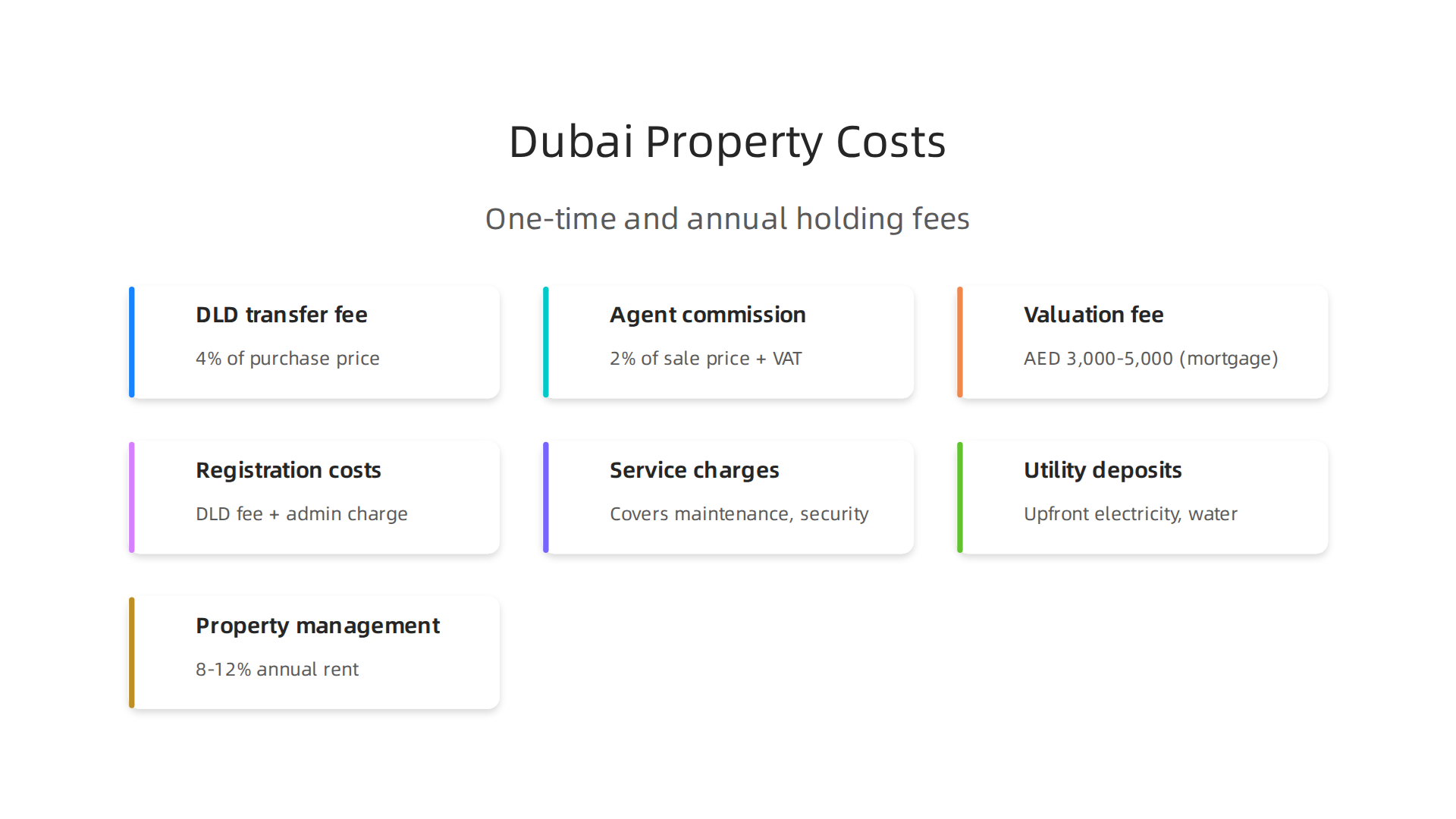
The biggest upfront cost is the Dubai Land Department (DLD) transfer fee. You must pay 4 percent of the purchase price when the property changes hands. On a AED 2 million apartment, that is AED 80,000 right away.
You will also pay:
- Agent commission – usually 2 percent of the sale price plus VAT
- Valuation fee – around AED 3,000 to AED 5,000 if you need a mortgage
- Registration costs – a small fee to the DLD, typically AED 4,000 plus VAT for properties under AED 500,000, and AED 4,000 plus 0.25 percent of the price for properties above that
If you plan to use financing, the costs increase. Most banks require a down payment of 35 to 50 percent for non-residents. The Dubai Mortgage for Non-Residents (2026 Guide) breaks down loan-to-value ratios and minimum deposits. Factor in bank processing fees too.
Annual Holding Costs
Once you own the property, you face ongoing expenses. The biggest is service charges. These cover maintenance, security, and common area upkeep. They vary by community. A luxury tower in Downtown Dubai may charge AED 20 to AED 30 per square foot per year, while JVC runs lower.
Other yearly costs include:
- Utility deposits – refundable, but you pay them upfront when connecting electricity and water
- Property management fees – if you hire a company to handle tenants and maintenance, budget 8 to 12 percent of the annual rent
- Home insurance – not required by law, but smart for protection
The Tax Picture (Good News)
Dubai offers a major advantage: no annual property tax. You never pay a recurring tax based on your property’s value. That is a huge relief compared to many other countries.
There is a 5 percent VAT on commercial properties and certain services like agent fees and management. But residential rent and residential property sales are exempt from VAT.
For a deeper look at how DLD and RERA regulate these costs, check this guide on Dubai’s real estate corporation and property protection. Understanding these fees now prevents surprises later and helps you calculate your true return from the start.
Summary
This guide walks you through how to buy property in Dubai in 2026, combining market data, legal rules, financing options and practical steps so you can act with confidence. It explains why Dubai still attracts investors—strong rental yields and steady price growth—while outlining recent regulatory protections like escrow accounts, expanded freehold zones and the Golden Visa. You’ll get a clear checklist of documents, a step‑by‑step purchase process (offer, deposit, SPA, DLD registration, handover), and realistic financing rules for residents and non‑residents. The guide compares off‑plan and ready properties, highlights top communities for income or capital growth, and breaks down one‑time and annual costs including the 4% DLD fee. Read this to avoid common mistakes, choose the right payment plan or mortgage, and know when to inspect, register and collect your keys. If you prefer personalized help, the article points to a free consultation to tailor choices to your goals.