Introduction
Are you thinking about buying property in Dubai? Maybe you have heard the buzz about real estate a Dubai and wondered if it is the right move for you.
You are not alone. The numbers speak for themselves. In the first quarter of 2026 alone, Dubai real estate transactions jumped 31% to reach Dh252 billion, according to data from the Dubai Land Department. Foreign investment stayed strong too, with total value increasing 26% to Dh148.35 billion. The city has become a global magnet for property buyers, drawn by its safety, incredible lifestyle, and major tax advantages.
But here is the thing. Investing in dubai real estate property as a foreigner comes with real challenges. Market ups and downs can feel scary. The rules and regulations are different from what you might be used to. And the sheer amount of information out there? It can overwhelm anyone.
That is why this guide exists. We built it for people like you who want a clear, data-driven roadmap for investing in the dubai real estate market in 2026.

No fluff. No sales pitch. Just the facts you need to make smart choices.
If you want to go even deeper into how to use market data to your advantage, check out this guide on data-driven digital marketing for Dubai real estate investors in 2026. It shows you how to turn information into real results.
Let us walk through everything you need to know about dubai and real estate investing as a foreigner.
Why Dubai? Understanding the Market’s Appeal for Foreigners in 2026
So why does dubai real estate attract so many international buyers right now? The answer comes down to a few major advantages that most other markets simply cannot match.
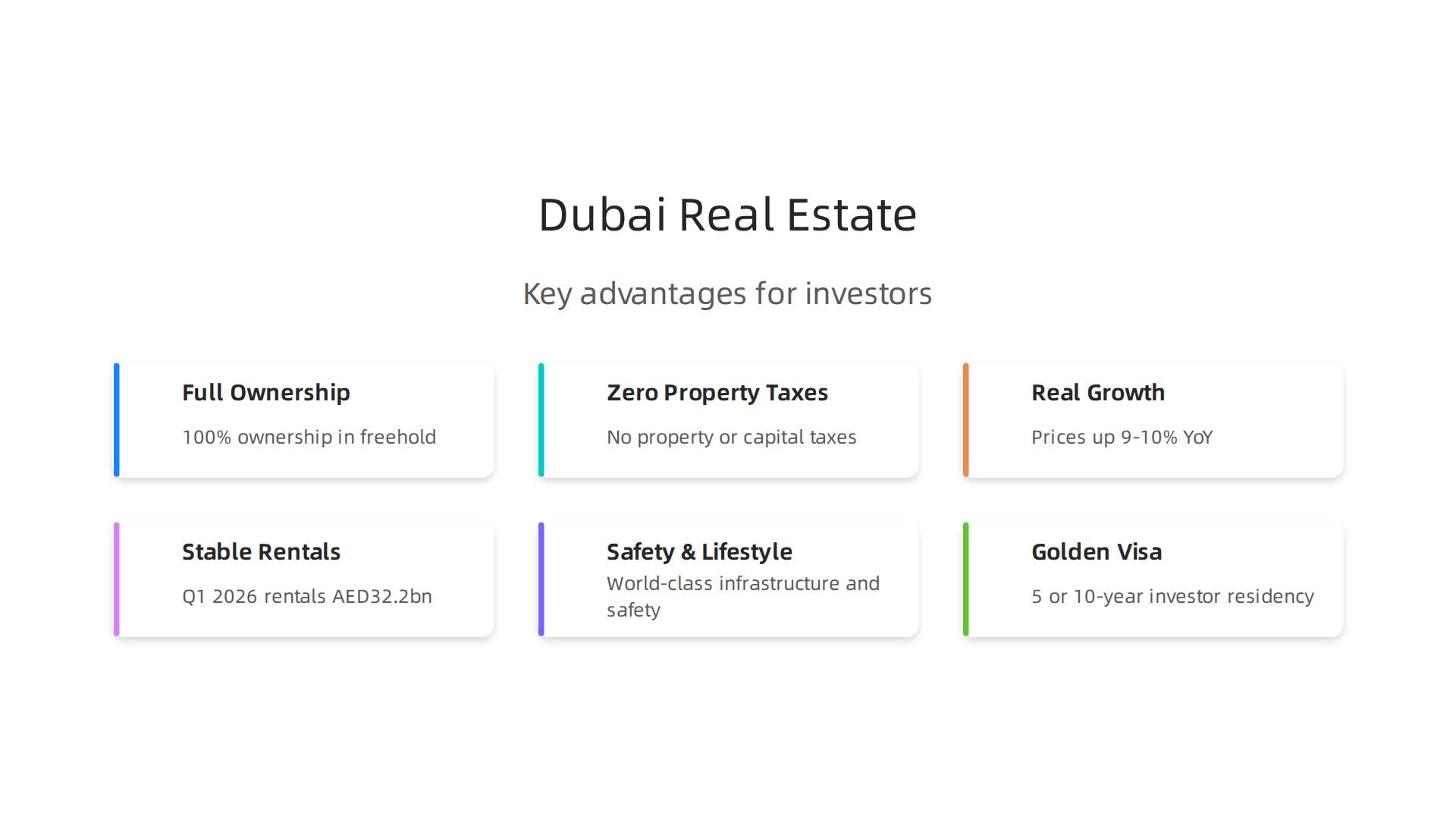
Full ownership and zero property taxes
First, the big one. Dubai allows 100% foreign ownership in designated freehold zones. That means you can own the property outright, no local partner required. And here is the part that surprises many first-time investors. There is no annual property tax. No capital gains tax. No stamp duty. Compare that to places like London, New York, or Singapore where taxes eat into your returns year after year. The savings add up fast.
Real growth you can see in the data
The numbers back up the hype. According to data from the Dubai Land Department, the dubai real estate market saw a 214% year over year increase in international real estate investments as of Q1 2025. And the momentum has carried into 2026. Property prices have risen roughly 9% to 10% year on year, based on recent market forecasts. That is steady, meaningful growth, not just a quick spike.
The rental market has stayed stable too. In Q1 2026, the total value of rental contracts hit AED32.2 billion, a sign that people are actually living in these properties, not just flipping them.
Safety, lifestyle, and the Golden Visa
But numbers only tell part of the story. Dubai offers a quality of life that keeps people coming back. The city is one of the safest in the world. The infrastructure is world class. And the government has made it easier than ever to stay long term with the Golden Visa program, which gives investors a 5 or 10 year residency visa when they buy property above a certain value.
You can dig deeper into how to use market data to track these trends with the Property Monitor Dubai 2026 guide. It shows you exactly how to check price movements and rental yields in real time.
For more official numbers, the Dubai Land Department research portal is a great place to verify market data yourself.
The bottom line? Dubai gives foreign investors a rare combination of ownership freedom, tax advantages, actual price growth, and a lifestyle that makes the investment feel good, not just smart.
Next, let us look at the different types of property you can buy and which option fits your goals best.
Legal Framework: Ownership Laws and Freehold Zones Explained
If you have ever wondered whether you can actually own property in Dubai as a foreigner, you are not alone. A lot of people assume the rules are complicated or restrictive. But here is the good news. Dubai has made it surprisingly simple.
Freehold zones: your full ownership option
Since 2002, the Dubai government has allowed foreigners to buy property in designated freehold areas. These are specific districts where you get 100% ownership rights, just like a local. No local partner required. No tricky loopholes. According to legal experts at Lym Real Estate, this was a game changer for international buyers looking at dubai real estate.
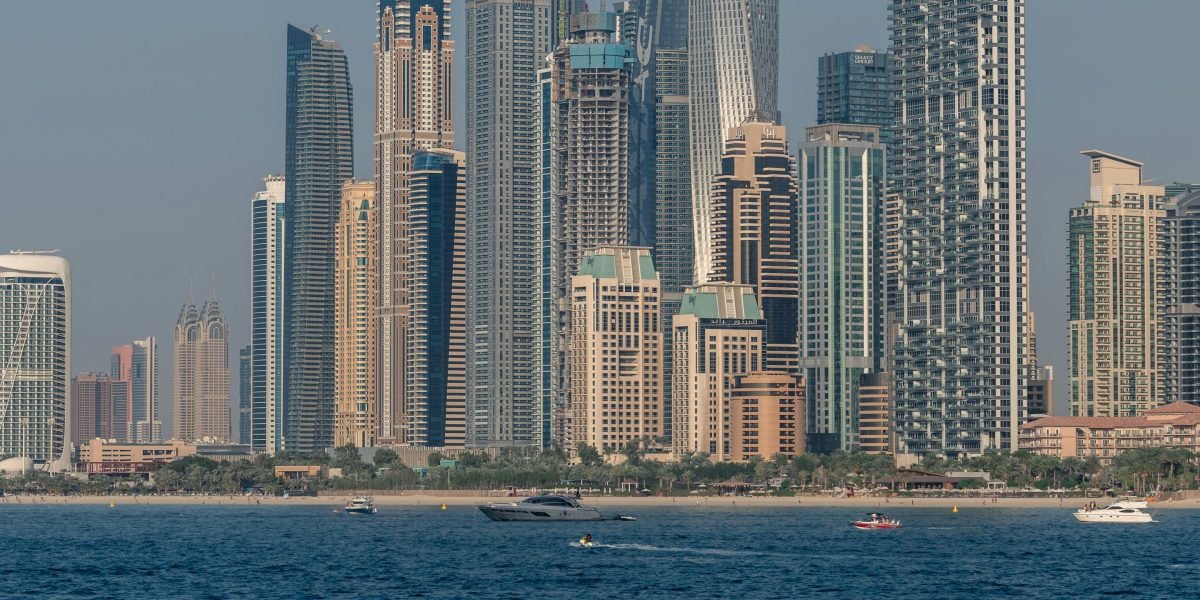
Popular freehold areas include Dubai Marina, Palm Jumeirah, Downtown Dubai, and Arabian Ranches. In these zones, you can buy villas, apartments, or townhouses and hold the title deed in your name.
Leasehold: another path for investors
Outside freehold zones, you still have options. Leasehold agreements let you own the property for up to 99 years. You do not own the land, but you own the building and can use it, rent it, or sell the lease. This is a common setup in some older or less central parts of the city.
A complete guide to freehold vs leasehold in Dubai 2026 breaks down the differences clearly if you are weighing both choices.
Who watches the market? DLD and RERA
Two government bodies keep everything fair and transparent. The Dubai Land Department, or DLD, handles all property registrations and transactions. The Real Estate Regulatory Authority, known as RERA, makes sure developers follow the rules. You can check the official DLD frequently asked questions page to verify any developer or project before you buy.
Every developer must be registered with RERA. Every sale must go through the DLD system. That means your purchase is protected by law from start to finish.
The Golden Visa: a smart bonus
Here is where the legal framework works in your favor beyond ownership. If you buy property worth AED 2 million or more, you can apply for a 10 year Golden Visa. This gives you residency rights, the ability to live and work in Dubai, and a path for your family to join you.
The step by step guide to finding property in Dubai explains exactly how to match your budget with the right visa eligible properties.
The bottom line
The legal system in Dubai is designed for foreign investors. Freehold zones give you full ownership. Leasehold zones give you long term control. DLD and RERA keep everything honest. And the Golden Visa makes it worth your while to invest at a higher level.
Understanding these laws is the first real step toward making a smart purchase. Next, let us look at the different property types available and which one fits your goals best.
Navigating the Property Purchase Process: Step by Step
So you understand the legal side of dubai real estate. Now comes the practical part. How do you actually buy a place?
The process is simpler than you might think. Here is a clear step by step walkthrough of how it works in 2026.
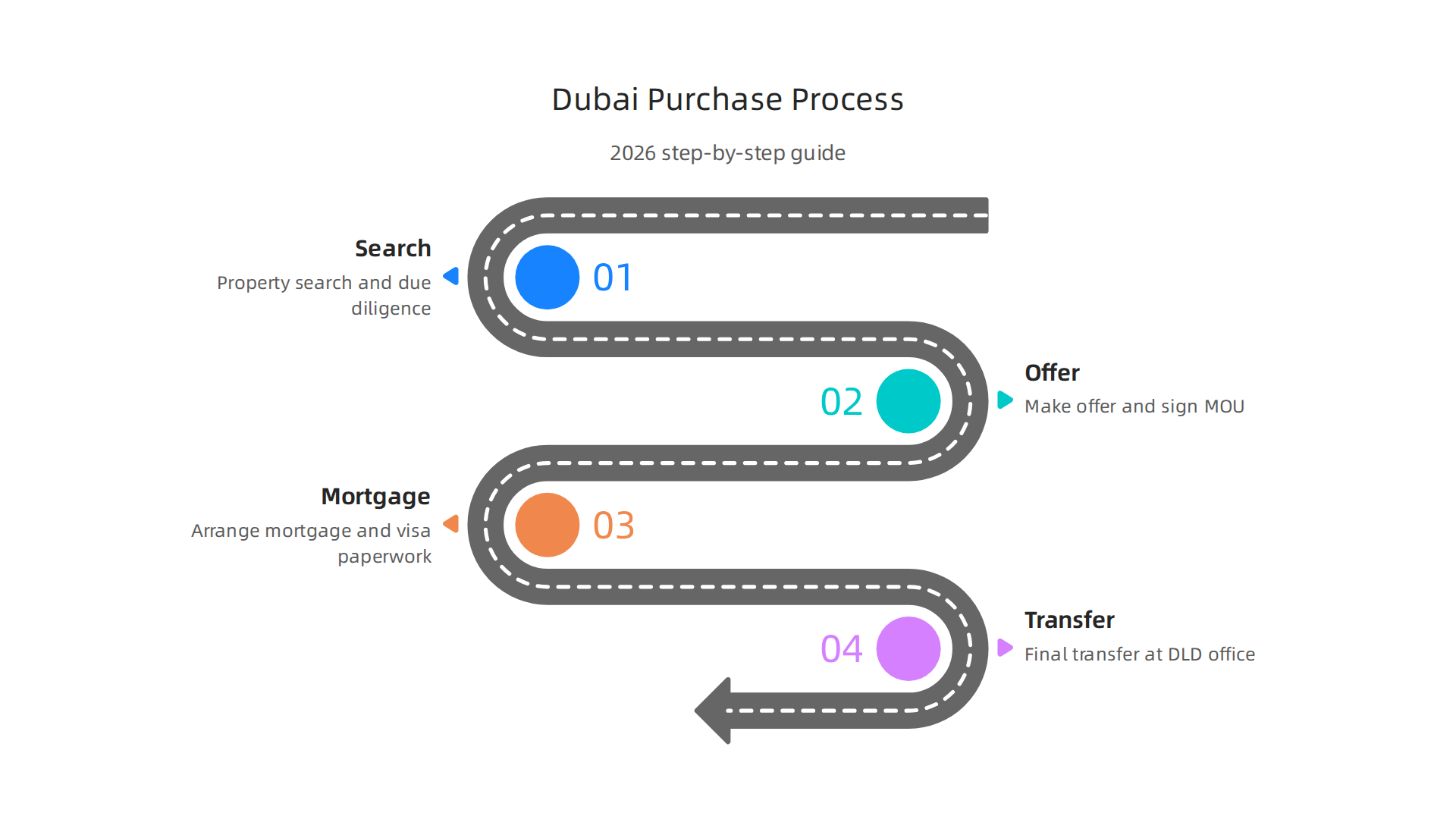
Step 1: Property search and due diligence
Start by looking at properties in your chosen freehold zone. Work only with a registered real estate agent. The Dubai Land Department keeps a list of licensed agents, so you can always check.
Before you make any offer, verify the developer is registered with RERA. You can do this on the official DLD website. This step protects you from scams and unfinished projects.
A good step by step guide to finding property in Dubai can help you match your budget with the right neighborhoods.
Step 2: Making an offer and signing the MOU
Once you find a property you like, you make an offer. If the seller accepts, both sides sign a Memorandum of Understanding, or MOU.

This document lays out the price, payment terms, and handover date.
You will pay a deposit at this stage, usually 10% of the purchase price. The legal steps outlined by Pearlshire explain that the MOU is the key contract that starts the official process.
Step 3: Arranging your mortgage and visa paperwork
If you need a mortgage, now is the time to finalize it. Most banks in Dubai offer home loans to foreign buyers, but you will need a UAE resident visa or a valid tourist visa to apply.
You may also need to open a local bank account. This is where your mortgage payments and transfer fees will come from. According to legal experts at Lym Real Estate, having a local account makes the entire process much smoother.
Step 4: Final transfer at the DLD office
This is the big day. You and the seller meet at a DLD trustee office or through an authorized agent. You pay the remaining balance. The DLD registers the property in your name.
You will pay a transfer fee, usually 4% of the purchase price plus some administrative costs. Once the system updates, you are the legal owner. The Baker McKenzie legal overview confirms that Dubai recognizes freehold title for foreign buyers in designated zones.
Why you need a legal advisor and a registered agent
Here is something I cannot stress enough. Always use a registered real estate agent and a local legal advisor. They handle the paperwork, check for hidden fees, and make sure every contract follows RERA rules. This is your best defense against fraud.
The whole process from offer to handover usually takes four to eight weeks. It sounds like a lot, but each step is designed to protect you.
Now that you know how to buy, let us look at the different property types available and which one fits your goals best.
Top Investment Communities: Where to Buy in Dubai for Maximum Returns
You now know how to buy property in Dubai. But the next question is just as important: where should you buy? The location you choose has a big impact on your rental income and long-term gains. Let me walk you through the top communities for dubai real estate investors in 2026.
Established favorites with strong rental demand
Some areas have proven themselves over and over. Dubai Marina, Downtown Dubai, Palm Jumeirah, and Jumeirah Lakes Towers (JLT) are well known for a reason. These communities have high occupancy rates and steady demand from tenants. If you want reliable monthly cash flow, these are solid choices.
According to data from Luxhabitat, the communities with the best rental yields in 2026 include International City, Discovery Gardens, Dubai Silicon Oasis, and Jumeirah Village Circle.

These areas o
ften offer higher yield percentages compared to luxury districts, as noted in a 2026 guide by Property Finder.
Emerging areas with higher growth potential
If you are looking for bigger returns over time, consider newer communities. Dubai South, Business Bay, and Dubai Creek Harbour are growing fast. They offer lower entry prices today but strong potential for capital appreciation as infrastructure develops.
The average gross rental yield for apartments in Dubai ranges from 5.86% to 5.11%, depending on size and location, according to GuestReady. That is much higher than what you would find in most global cities. A report from Gulf Invest highlights that high rental yields and a tax-free environment continue to attract investors from around the world.
Yield comparison across communities
Here is a quick look at how different areas compare in 2026.
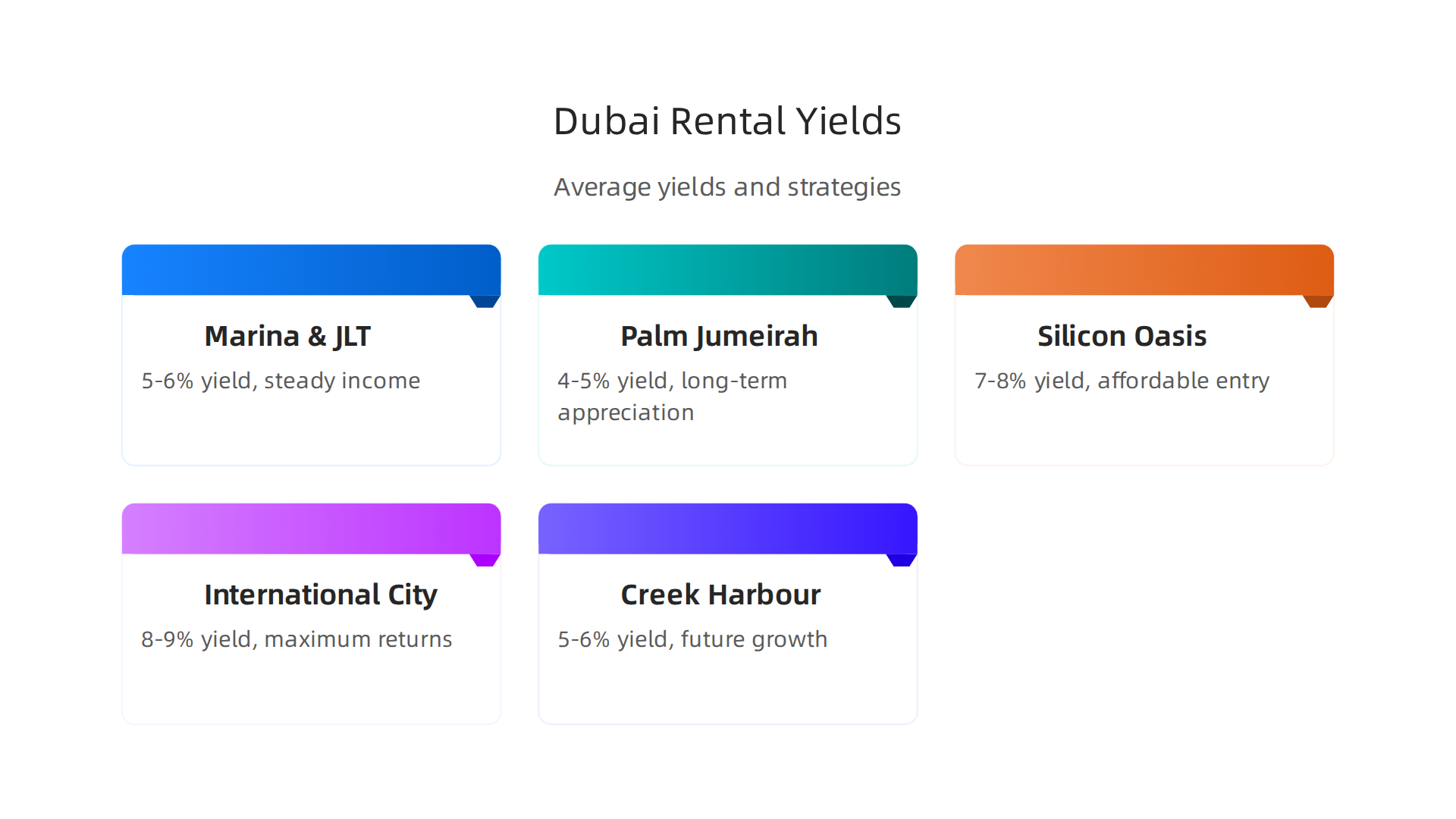
| Community | Average Rental Yield (2026) | Best For |
|---|---|---|
| Dubai Marina / JLT | 5% to 6% | Steady rental income, high tenant demand |
| Palm Jumeirah | 4% to 5% | Luxury market, long-term capital appreciation |
| Dubai Silicon Oasis | 7% to 8% | Higher yield, affordable entry price |
| International City | 8% to 9% | Maximum rental return, budget investment |
| Dubai Creek Harbour | 5% to 6% | Future growth, new development upside |
Data compiled from Luxhabitat, GuestReady, and Property Finder.
Which community matches your strategy?
Here is the thing. There is no single best area for everyone. If you want reliable rental income today, go with established communities like Dubai Marina or JLT. If you are willing to wait for growth, emerging areas like Dubai South or Dubai Creek Harbour could pay off bigger in the long run.
You can explore a full step by step guide to finding property in Dubai to match your budget with the right neighborhood.
Dubai real estate offers strong returns across many communities. The key is picking the one that fits your goals and timeline. Now that you know where to buy, let us look at how to make your final decision and close the deal with confidence.
Financial Deep Dive: Rental Yields, Capital Appreciation, and Associated Costs
Now that you know which communities offer the best returns, let us talk about the numbers that really matter. When you invest in real estate a dubai, three things decide your profit: rental yield, capital appreciation, and the ongoing costs you must pay. Get these right, and your investment will work hard for you.
Rental yields: why Dubai stands out
Here is the thing. Dubai real estate offers some of the highest rental yields in the world. Depending on the area, you can earn between 5% and 9% gross rental yield per year. According to Luxhabitat, communities like International City and Dubai Silicon Oasis push toward the higher end of that range. And GuestReady reports that the average gross yield for apartments falls between 5.11% and 5.86%.
But here is the real kicker. You pay zero income tax on that rental income. The Gulf Invest report highlights that tax free earnings are a major reason global investors choose Dubai. Compare that to cities like London or New York, where taxes eat a big chunk of your returns.
Capital appreciation: steady but patient
Capital appreciation in dubai and real estate has been more moderate compared to some boom markets. But it has been steady and reliable. Ready properties in established areas tend to appreciate 3% to 5% per year on average. Off plan properties in growing communities like Dubai Creek Harbour or Dubai South can see higher upside, but you need a longer timeline.
If you want both rental income and long term growth, your best bet is to pick a balanced community. A quick YouTube roundup of the top 2026 areas shows that yield focused neighborhoods often double as good appreciation plays.
The costs you cannot ignore
Profit is not just what you earn. It is what you keep after costs. Here are the main expenses for any dubai real estate property owner:
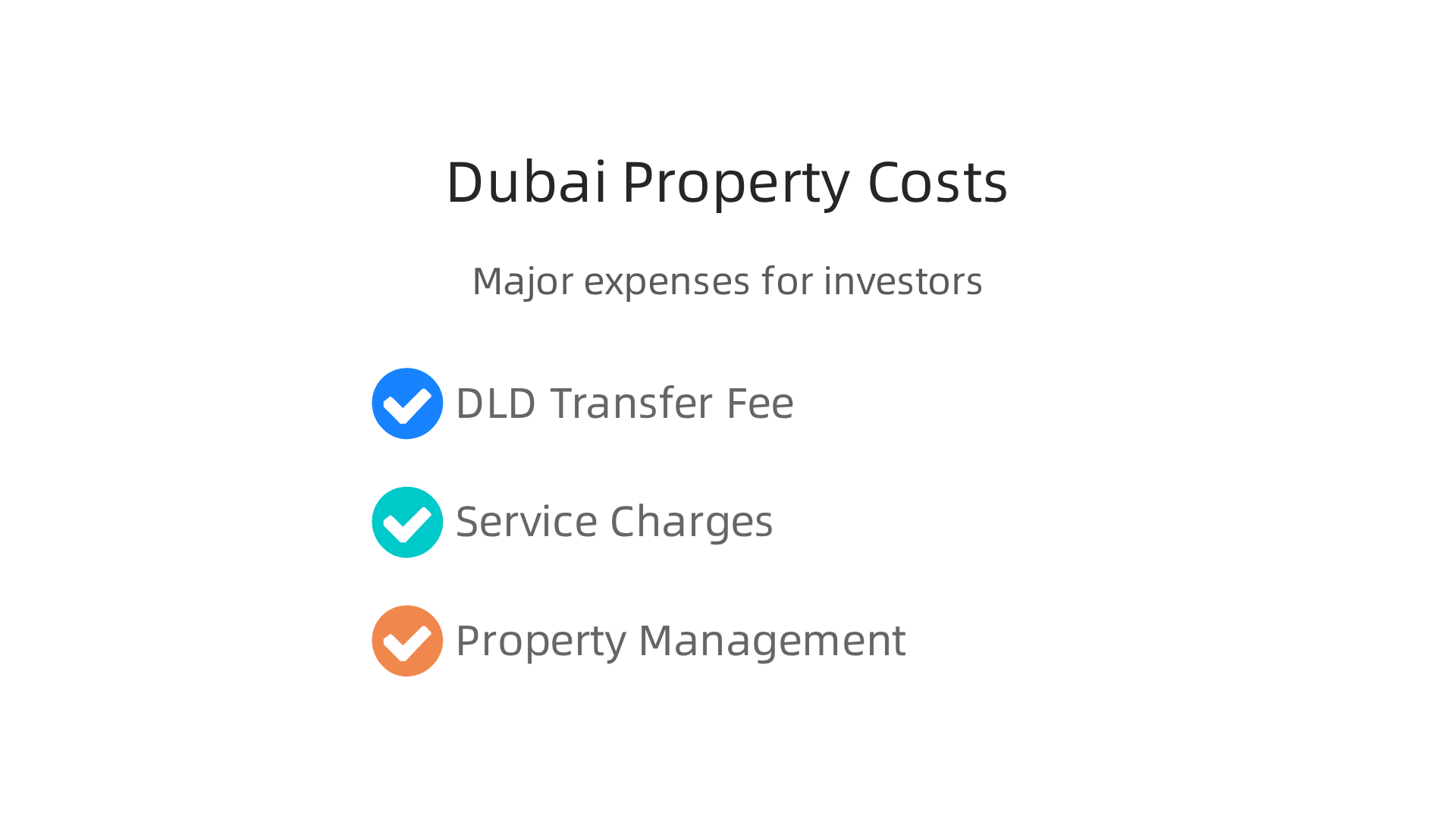
| Cost | Typical Amount |
|---|---|
| Dubai Land Department transfer fee | 4% of purchase price plus admin fees |
| Service charges | Varies by community, usually AED 10–25 per sq ft per year |
| Property management fees | 5% to 10% of annual rent if you hire a manager |
The DLD fee is a one time cost when you buy. Service charges cover maintenance of common areas, security, and utilities in the building. And if you do not want to handle tenants yourself, expect to pay a management company about 8% of your rental income.
A Property Finder guide advises investors to always factor in these fees when calculating net yield. Your gross yield might be 7%, but after service charges and management, your net yield could drop to 5% or 6%. Still very good compared to most global markets, but you need to know the real number.
To track your potential returns across different communities, you can use a tool like Property Monitor to get real time data on yields and price trends.
So to wrap up: real estate a dubai gives you strong rental income, tax free gains, and steady appreciation. Just remember to subtract the costs before you celebrate your returns. Now you know the full financial picture. You are ready to make a smart move.
Off‑Plan vs. Ready Property: Which Strategy Is Right for You?
You know the numbers. You know the costs. Now it’s time to choose your entry strategy. When investing in real estate a dubai, the biggest fork in the road is this: do you buy off-plan or ready? Each path works well. But they serve very different investor goals.
The off-plan advantage
Off-plan means you buy a property before construction finishes. Developers offer lower entry prices here. They also give you flexible payment plans that stretch over months or years. This means you can secure a unit without paying the full price upfront.
The real upside? Capital appreciation during construction. As the building rises, the value of your unit often rises too. According to a detailed ROI comparison from APIL Properties, many investors see strong paper gains before they even take possession.
But there is a downside. Off-plan projects can face delays. Some even get canceled. If your goal is safety first, this matters. Many experienced investors have moved away from off-plan in 2026. One investor on YouTube explains exactly why they now prefer ready properties to protect their capital.
The ready property advantage
Ready properties are move-in ready. You can buy today and have a tenant living there next month. That means you start earning rental income immediately. No waiting.
You also get clarity. You can see the actual unit, the view, the finishes. There are no surprises. The valuation is real and clear. This lowers your risk significantly.
The trade-off is price. Ready properties typically cost more than similar off-plan units. A comparison by Betterhomes confirms that you pay a premium for convenience and immediate income.
Which one fits your life?
Ask yourself these questions:
- Do you need cash flow right now? If yes, go ready.
- Can you wait 2 to 4 years for returns? If yes, off-plan might suit you better.
- Do you have low risk tolerance? Ready gives you more certainty.
- Do you want maximum upside potential? Off-plan wins here.
Whichever path you pick, you need a trustworthy developer. Our guide to the top real estate companies in Dubai for 2026 helps you compare the builders who actually deliver on time.
If you still feel unsure about which strategy matches your budget and goals, don’t worry. Our step-by-step guide to finding property in Dubai walks you through the entire process from start to finish. You will know exactly what to do next.
Tax Efficiency and Repatriation: Understanding Dubai’s Tax Regime for Investors
Now that you have chosen your path between off-plan and ready property, here is the part that really makes Dubai stand out. The tax rules.
Dubai does not charge personal income tax, capital gains tax, or property tax. That is a huge deal for overseas investors. When you earn rental income or sell a property for profit, the government does not take a cut. This is one of the main reasons people move their money into dubai real estate.
But there are a few costs you need to know. When you buy a property, you pay a one-time 4% DLD transfer fee to the Dubai Land Department. That is it for the purchase. After that, your ongoing costs are mostly service charges for building maintenance, and those can be tax-deductible if you invest through a company structure.
The best part? Repatriation. You can move your rental income or sale proceeds out of Dubai anytime, to anywhere in the world, with no restrictions. No exit taxes. No extra paperwork. This is a major reason why dubai and real estate have become so popular with global investors.
However, you still need to follow your home country’s tax laws. For example, if you live in a country that taxes worldwide income, you may still owe taxes there. Always check with a local tax advisor before you invest.
To make sure you keep track of your net returns, use tools like a property monitor for real-time market data in Dubai to stay informed about market movements that affect your bottom line.
Want a complete walkthrough of the buying process? Our step-by-step guide to finding property in Dubai helps you navigate every stage, including tax planning.
Risk Management and Due Diligence for Foreign Investors
Every investment comes with some risk. And investing in real estate a Dubai is no different. But here is the good news. You can avoid most common problems with smart due diligence.

Let us look at what you need to watch out for.
The main risks include market volatility, legal complexities, and hidden financial costs. That is according to Engel & Völkers. If you go off-plan, project delays are a real concern. Some segments also face oversupply, which can lower your rental income. And regulatory changes can sometimes catch investors off guard.
So how do you protect your money?
Start with the developer. Check their track record carefully. Have they finished past projects on time? Do they have a good reputation? The 4 pillars of due diligence for Dubai off-plan properties video walks you through exactly what to check before you sign anything.
Next, verify the property itself. You need to check title deeds, physical condition, and legal clearances. A solid real estate due diligence checklist helps you cover everything before you commit.
Working with a registered real estate agent is a big help. A good agent knows the market and can spot red flags early. A legal consultant who specializes in dubai real estate law is also worth the money.
For a full 2026 walkthrough of the entire buying process, the GuestReady guide to buying property in Dubai covers regulations and how to make informed choices.
To stay on top of market shifts that affect your investment, use a property monitor for real-time market data in Dubai. It helps you spot changes early and adjust your strategy.
If you want to compare the top developers side by side, check out our Emaar, Damac, and FAM comparison to see who has the strongest track record.
The bottom line? Do your homework. Verify everything. Work with trusted professionals. That is how you turn dubai and real estate from a risky gamble into a smart, long term investment.
Summary
This guide explains how foreigners can invest in Dubai real estate in 2026, covering why the market is attractive, the legal framework, and the practical steps to buy. It reviews freehold and leasehold ownership, the role of DLD and RERA, and how the Golden Visa ties into higher-value purchases. You’ll get a clear walkthrough of the purchase process—from search and MOU to mortgage and final transfer—plus timelines and typical costs. The article compares top investment communities, expected rental yields (roughly 5–9% depending on location), and the trade-offs between off‑plan and ready properties. It also breaks down taxes, repatriation rules, and common expenses like the 4% DLD transfer fee and service charges. Finally, the guide shows how to manage risks with developer checks, due diligence, and real-time market tools so you can make an informed investment decision.