Introduction: Navigating Dubai’s Evolving Property Market in 2026
Thinking about investing in Dubai property in 2026? You are not alone. Thousands of buyers, from first-time investors to seasoned portfolio managers, are trying to make sense of where the property price in UAE is heading next.

Here is the challenge. You can find raw transaction numbers everywhere. But turning those numbers into a smart investment decision? That is much harder. You might scroll through data from the Dubai Land Department, read news headlines, or ask friends for advice. After all that, you still end up wondering: Am I buying at the right time? Is this community going to grow?
This article is here to close that gap.
Dubai’s real estate market has shown remarkable strength through recent years.
The Dubai Real Estate Price Index records 9.81% growth in 2025, with villas leading the charge at nearly 15% annual increase. And 2026 has started with even more momentum. January 2026 alone saw over 16,900 sales transactions, pushing the average price per square foot to 1,976 AED — an 18% jump from the same month last year.
So the market is moving. But understanding the real estate market in Dubai right now means knowing more than just the averages. You need to know which segments are hot, where value still exists, and how to build a portfolio that can handle shifts in demand.
That is exactly what this guide covers. We break down verified data from trusted sources and pair it with practical insight you can actually use. Whether you are looking at off-plan launches, ready-to-move villas, or income-generating apartments, knowing the current property price in UAE trajectory helps you time your entry, pick the right community, and invest with confidence.
If you want to go deeper into how to find the best opportunities right now, our detailed data-backed insights and investment opportunities page lays out the top areas and strategies for 2026.
Ready to make your move in this exciting market? If you want to take the next step, you can get a FREE Dubai Real Estate Consultation with an expert who understands this market inside and out.
Key Economic and Demographic Drivers Shaping Property Prices in 2026
Now that you have seen the raw market numbers, let us look at what is actually moving the needle. The property price in UAE does not rise on its own. A few powerful forces are working together beneath the surface.
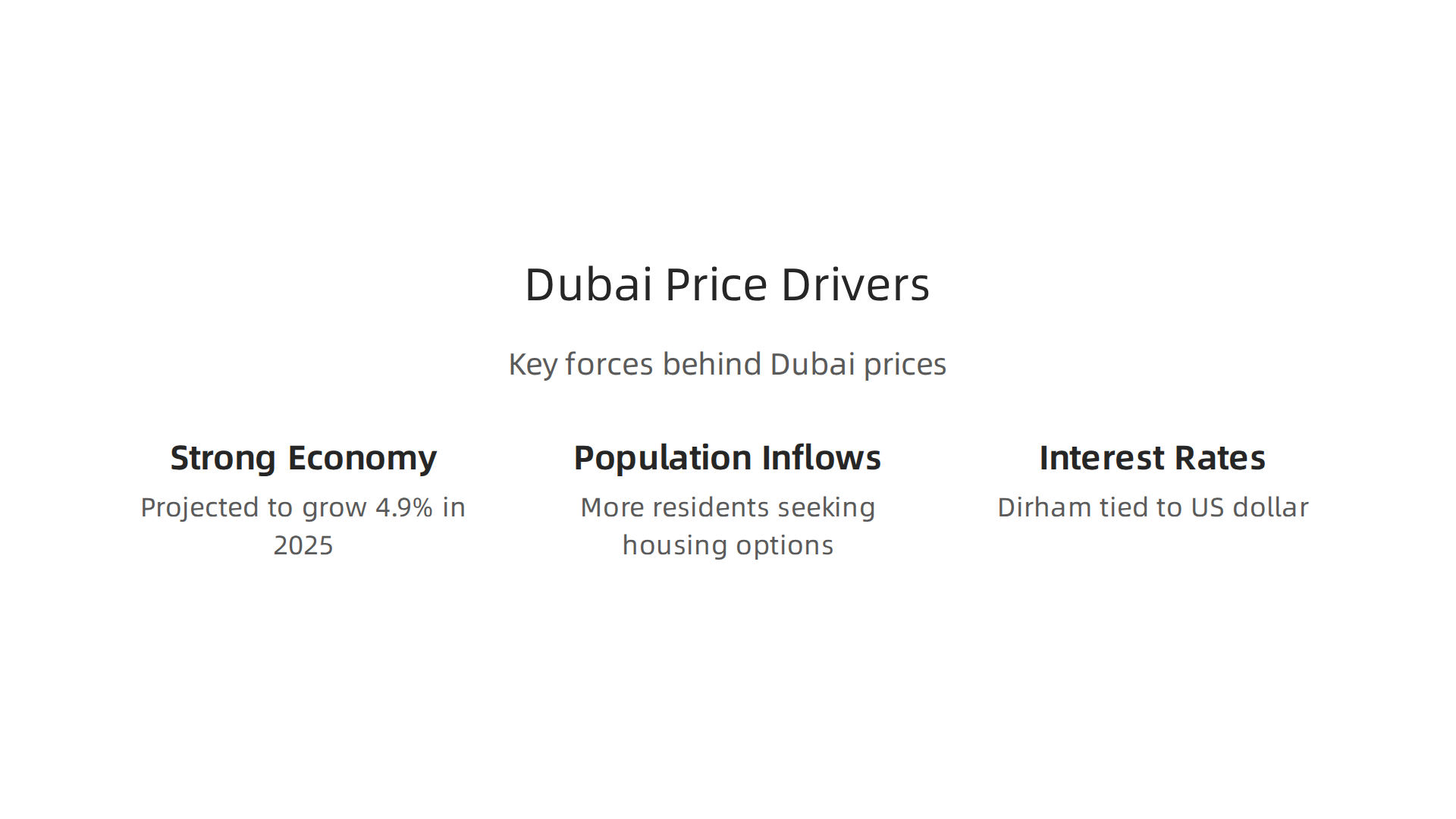
Understanding them helps you see where the market is heading next.
A Strong and Diversifying Economy
Dubai’s economy is growing at a steady clip. According to the Central Bank, the UAE economy is projected to grow 4.9% in 2025 and 5.3% in 2026. That is not just a number on a chart. It means more companies opening offices, more jobs being created, and more people with money to spend on housing.
But here is the part that matters most for investors. The growth is not coming from one source. Dubai has worked hard to build strength in tourism, technology, financial services, and manufacturing. All of these sectors are contributing more every year. The construction industry grew by 11.1% in 2025, and the real estate sector itself saw a 7.9% increase according to UAE real GDP growth in 2025 data. When the economy runs on many engines, demand for property stays steady even when one area slows down. This is a big reason why the real estate market in Dubai has stayed resilient.
People Keep Moving to Dubai
The second driver is simple. More people are arriving every month. Visa reforms like the golden visa and remote work programs have opened the door for skilled professionals, entrepreneurs, and investors from around the world. These policies are designed to attract people who want to live here long term and put down roots.
Every new resident needs a place to live. That means more renters looking for apartments and more buyers searching for villas. This expanding pool of demand puts steady upward pressure on prices. Communities with good schools, transport links, and lifestyle amenities benefit the most. If you are deciding where to buy, following where people are moving is a smart strategy.
Interest Rates and the Currency Link
Global interest rates play a direct role in how the property price in UAE behaves. Because the UAE dirham is tied to the US dollar, local interest rates follow the US Federal Reserve closely. When the Fed cuts rates, borrowing gets cheaper for buyers here too.
The Central Bank of the UAE recently lowered its base rate to 4.15%, matching the Fed’s move. Lower mortgage costs make it easier for buyers to qualify for loans and afford higher prices. That tends to push property values up. Investors who track rate trends can find better entry points by timing their purchases around these shifts.
Putting It All Together
These three drivers — economic growth, population inflows, and interest rate policy — create a healthy foundation for real estate investments in Dubai. They do not guarantee that every property will go up in value. But they create conditions where smart choices have room to grow.
If you want to explore how these trends apply to specific communities and property types, our uae property prices 2026 guide breaks it all down by area and price range.
Residential Property Price Trends by Key Dubai Communities (2024–2026)
The numbers we covered so far tell a big picture story. But here is where things get practical. The property price in UAE does not move the same way everywhere. Some areas are soaring. Others are quietly climbing. A few are just getting started.
If you want to buy or invest, knowing which neighborhood fits your goal is half the battle. Let us walk through three tiers of communities so you can see where your money might work hardest.
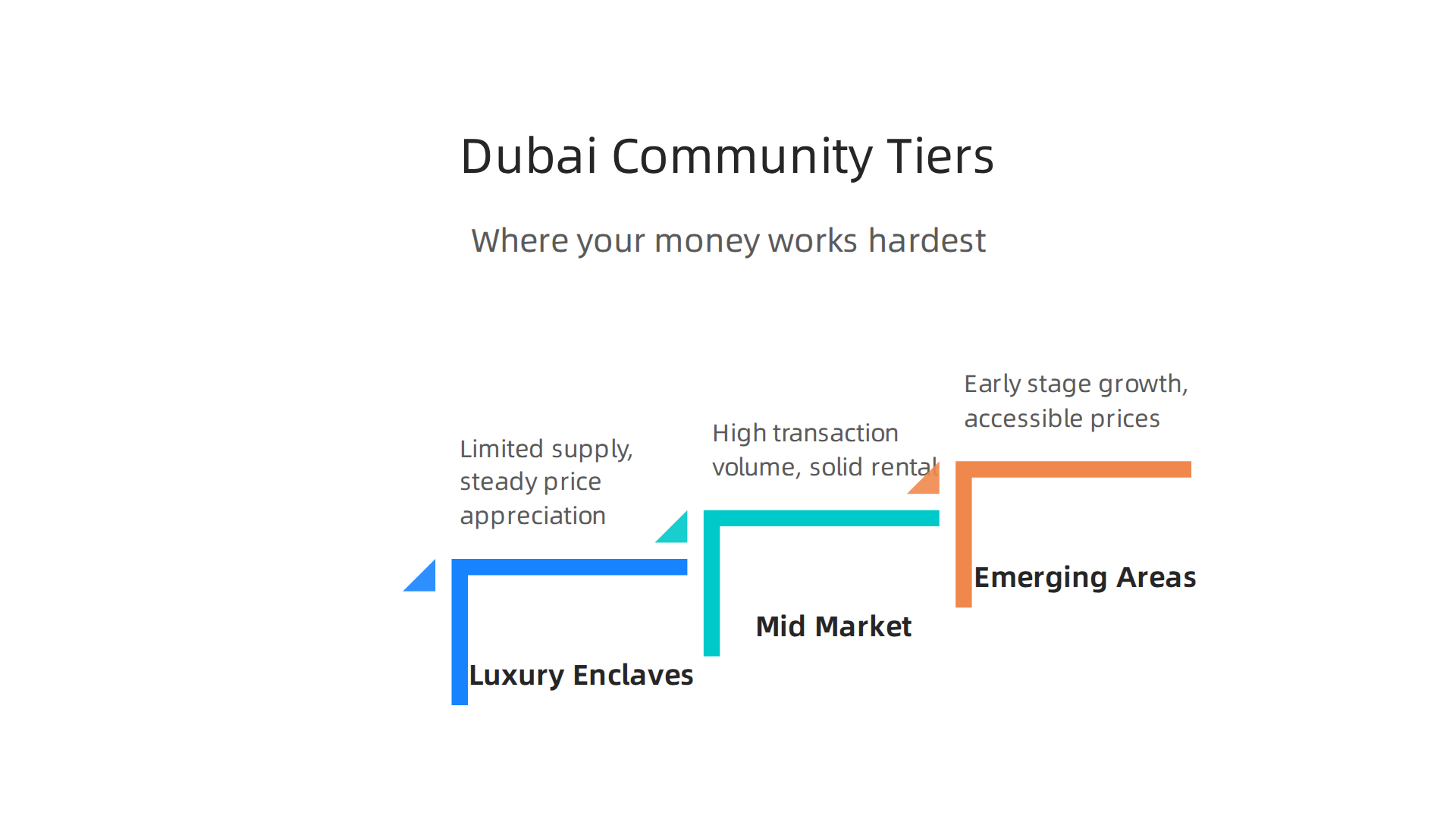
Luxury Enclaves: Palm Jumeirah and Emirates Hills
These areas are in a league of their own. Limited supply meets endless demand from high net worth individuals moving to Dubai. The result is steady price appreciation that rarely pauses.
On Palm Jumeirah, the average price per square foot hit about AED 4,240 in mid 2026 according to price per square foot by community in 2026 data from Engel & Voelkers. Villas in prime waterfront spots here have seen double digit growth year after year. Emirates Hills follows a similar pattern. These are not areas where you look for bargains. They are areas where you park capital and watch it grow steadily.
The buyers in these communities are often cash buyers from Europe, Asia, and the Middle East. They want privacy, space, and prestige. If that sounds like your profile, luxury real estate in Dubai remains a strong move.
Mid Market Communities: JVC and Dubailand
This is where the real action is happening for most investors. Areas like Jumeirah Village Circle (JVC) and Dubailand have become the engine room of the real estate market in Dubai. Transaction volumes here are massive.
JVC alone recorded nearly 1,900 deals in Q1 2026 at a median price of about AED 1,500 per square foot. That is a lot of activity. Buyers here are a mix of young professionals, small families, and investors looking for solid rental yields. The apartments and townhouses in these areas offer good value without sacrificing lifestyle.
If you are looking for a ready to move property in Dubai, these mid market communities are worth a serious look. They offer immediate rental income potential and strong demand from tenants.
Emerging Areas: Dubai South and Al Furjan
Here is where the smart money is watching closely. Emerging communities like Dubai South and Al Furjan are still in the early stages of price growth. Infrastructure is developing fast. New roads, schools, and retail centers are coming online.
Dubai South, located near the Expo 2020 site and Al Maktoum International Airport, is positioned to become a major hub. Prices here are still accessible compared to more established areas. Al Furjan offers a similar story with its villa communities attracting families who want more space for less money.
These areas may not give you instant returns. But they offer early stage value appreciation that can compound nicely over three to five years. If you have patience and eyes on the long game, emerging communities deserve a spot on your shortlist.
Matching Your Strategy to a Community
Each tier serves a different purpose. Luxury enclaves protect and grow wealth slowly. Mid market areas generate steady cash flow and high transaction volume. Emerging zones reward investors who buy before the crowd arrives.
The key is matching your personal goals to the right area. Not every investor needs a Palm Jumeirah villa. Not everyone wants to wait for Dubai South to mature. But understanding the differences helps you make a choice you will feel good about later.
If you are unsure which community fits your budget and goals best, a quick conversation with someone who lives and breathes this market can save you months of research.

Reach out for a FREE Dubai Real Estate Consultation to get personalized guidance tailored to your situation.
Rental Yields and Capital Appreciation: A Data-Driven Performance Review
We have talked about where prices are going. But price growth is only half the story. The other half is what you earn while you own the property. That is where rental yields and capital appreciation come in.
Dubai stands out on the global stage for one big reason. The rental income here is very strong. According to recent data, the gross rental yields in Dubai reached around 6.78% in 2026. That is significantly higher than most major cities in Europe or Asia. When you look at the property price in UAE compared to rental income, the numbers make a lot of sense for investors.
The real estate market in Dubai is not just about buying low and selling high. It is about collecting steady monthly returns. Apartments in communities like JVC and Dubailand regularly offer yields between 6% and 8%. That kind of cash flow is hard to find in other global markets.
But yields vary a lot depending on where you buy. Luxury enclaves like Palm Jumeirah give you lower rental yields. You might see 4% to 5% there. But the trade off is stronger capital appreciation. The luxury segment saw prices jump significantly in 2025. The overall Dubai property index grew 9.81% in 2025, with villas leading the charge at nearly 15% growth.
So which one should you chase? High yield or high appreciation? The smartest real estate investments in Dubai usually balance both. You want a property that pays you well each month and also gains value over time.
That brings us to the rent to price ratio. This simple number helps you spot undervalued areas. If a property costs AED 1 million and rents for AED 80,000 a year, the yield is 8%. That is a strong buy signal for income investors. If the same property costs AED 2 million but still rents for AED 80,000, the yield drops to 4%. In that case, you are betting purely on future price gains.
One thing every investor should factor in is the property management cost. High yields look great on paper. But after management fees, maintenance, and service charges, your net return may be lower. Always calculate your net yield, not just the gross number.
If you want to run these numbers on specific properties, a good place to start is a data-driven investment toolkit that breaks down yields by community. That kind of analysis takes the guesswork out of your next move.
Regulatory Changes and Their Impact on Property Prices in 2026
Now let us talk about something that quietly moves the needle on the property price in UAE more than most people realize. That is regulation. The rules changed a lot in 2026. And those changes are reshaping the real estate market in Dubai in real ways.
The biggest shift is in visa rules. Dubai expanded its Golden Visa program and introduced clearer pathways for long term residency. The old minimum property value of AED 750,000 was removed for sole property owners under the updated 2 year investor visa rules. That alone opened the door for more buyers. When more people qualify to live here, demand for housing goes up. And when demand goes up, prices follow.
The 5 year Green Visa also got simpler. Professionals, freelancers, and investors can now secure longer stays without needing a local sponsor. This change matters because it turns short term visitors into long term residents. And long term residents buy homes.
Mortgage rules also shifted in 2026. The central bank adjusted loan-to-value ratios and mortgage caps. For first time buyers, the loan to value ratio remains generous. But for second home buyers and investors, the caps tightened slightly. This affects how much you can borrow and what kind of property management cost you need to budget for. If borrowing gets slightly harder for some groups, it can cool demand in certain price brackets. That is something to watch closely.
On the ownership side, regulators introduced new protections for foreign investors. A major update came through the New Civil Code, which rebalanced rights between buyers, sellers, and developers. Developers can now retain ownership until full payment is received. Deferred payment plans are legally validated. The defect claims period extended from 6 months to a full year. These are not small tweaks. They change how safe you feel when signing a contract.
Dubai also rolled out smarter rental oversight through RERA in 2026. A data driven Smart Rental Index now tracks market rates more accurately. Stricter enforcement of notice periods and rent increases means both landlords and tenants operate with more transparency. That stability encourages more people to enter the market, which supports the real estate investments Dubai ecosystem.
For a deeper look at how the Dubai Land Department and RERA protect buyers like you, check out this overview of the Dubai real estate corporation and RERA protections. It explains the legal backbone behind every transaction.
These major regulatory updates for Dubai real estate in 2026 are not just paperwork. They directly affect supply, demand, and the property price in UAE you will pay or earn. The market is becoming more transparent and more accessible. That is good news for serious investors.
Ready to take the next step? The rules are now clearer than ever. If you want personalized help finding the right property at the right price, connect with Ayaz Salman for a free consultation on buying, selling, or investing in Dubai.
Off‑Plan vs Ready Property: Price Dynamics and Investor Considerations
Now let us look at the two main paths you can take: off‑plan and ready properties.
Each one affects the property price in UAE you pay and the returns you get. And the choice you make depends on your timeline, your budget, and how much risk you can handle.
Off‑plan properties are sold while still under construction. Developers offer these units at a lower price to attract early buyers. In 2026, off‑plan sales have rebounded strongly. Flexible payment plans let you spread out payments over the build period. That means you do not need all the cash upfront. According to a detailed Off-Plan vs Ready Property in Dubai 2026 guide, off‑plan units often cost 15 to 30 percent less than ready units in the same area. You also see capital appreciation of 15 to 25 percent by the time the project finishes. But there is a catch. Completion risk is real. Delays happen. And if the developer runs into trouble, your timeline gets stretched. That is something every buyer needs to weigh.
Ready properties are the opposite. The building is finished. You can walk in today. You get immediate rental income, clear valuation, and zero construction risk. But you pay a premium for that certainty. The upfront cost is higher. You usually need a larger down payment, especially if you are a non‑resident. For many investors, the trade‑off is worth it. You know exactly what you are getting. And the cash flow starts right away. For a deeper look at this option, check out this guide on ready to move property in Dubai for 2026.
Here is where the price dynamics get interesting. In 2026, the gap between off‑plan and ready prices has narrowed in prime areas like Downtown and Dubai Marina. Buyers are snapping up ready units at only a small premium. But in emerging communities like Dubai South and Town Square, the gap stays wider. Off‑plan can be 20 to 25 percent cheaper. That creates a clear opportunity if you are willing to wait.
Your choice affects the real estate market in Dubai in a personal way. Off‑plan fits long‑term goals and lower initial budgets. Ready suits immediate cash flow and certainty. Both can be part of a smart real estate investments Dubai strategy. The key is matching the option to your own situation.
Think about your property management cost too. Ready properties need maintenance right away. Off‑plan lets you delay those costs until handover. Factor that into your numbers before you decide.
Future Outlook: Expert Price Forecasts for 2026-2027
So what do the experts actually see coming next for the property price in UAE? After two years of strong gains, the market is shifting into a new phase.

And knowing what is ahead can help you make smarter moves right now.
Most analysts agree on one thing. Price growth in 2026 will moderate to single digits. That is a big change from the double-digit jumps of 2024 and 2025. Knight Frank forecasts roughly 3 percent growth for prime properties and about 1 percent for mainstream areas this year. Cushman and Wakefield is a bit more optimistic, projecting 5 to 8 percent growth. The realistic range from most institutional forecasts lands between 3 and 6 percent for the full year, according to a detailed Dubai property price forecast analysis.
But here is the nuance. Not all segments will move the same way. Communities with active infrastructure projects like Expo City and Dubai Creek Harbour are expected to outperform the citywide average. Why? Because new roads, schools, and transit lines drive demand in those pockets. And limited supply of prime villas in established neighborhoods keeps upward pressure on prices there.
The biggest downside risk is oversupply. Around 110,500 new units are in the delivery pipeline for 2026. That is more than triple the number completed in 2025. Knight Frank assumes only about 70 percent of those will actually finish on time, based on historical delivery rates. But even that volume could put downward pressure on prices in certain mid-market segments. Apartments under AED 1 million in oversupplied districts are the most vulnerable.
Global economic conditions also matter. Interest rate changes by the US Federal Reserve affect mortgage costs in Dubai because the dirham is pegged to the dollar. A slowdown in major economies could reduce demand from foreign buyers. The UAE economy itself remains strong, with the Central Bank projecting 5.3 percent GDP growth in 2026, as noted in this UAE economic outlook article. That provides a solid foundation underneath the property market.
For investors who focus on the long term, the base case looks healthy. Most analysts project cumulative growth of 20 to 25 percent over the next five years. That works out to roughly 4 percent average annual appreciation. The key is choosing the right community and the right property type. Areas with real infrastructure value hold up better during slower periods. For a deeper look at where the numbers point, check out this data-backed market outlook for Dubai 2026.
Are you ready to make your next move with confidence? FREE Dubai Real Estate Consultation with Ayaz Salman can help you match the forecast to your own goals.
Summary
This article explains how Dubai’s property market is behaving in 2026 and what that means for buyers and investors. It reviews recent price performance, the economic and demographic forces driving demand, and how interest‑rate moves tied to the US dollar affect borrowing costs. The guide breaks down performance by community tiers—luxury enclaves, mid‑market hubs, and emerging areas—so you can match a neighbourhood to your investment goals. It also compares off‑plan versus ready properties, shows how rental yields and net returns vary across locations, and outlines major 2026 regulatory updates that change who can buy and how safely they can do so. Practical forecasts and numbers let you estimate short‑term moderation in growth and longer‑term upside, while action steps and tools point to how to pick, price and manage an investment property in Dubai.