Introduction
Dubai’s property market has a way of pulling people in. Whether you are looking at the city’s tax-free setup, the promise of strong rental returns, or the chance to own property as a foreigner, there is a lot to like. And in 2026, the market is still drawing attention from around the world. According to the Dubai Housing Market 2026 analysis, rental yields in Dubai remain high by global standards, which continues to attract international investors.
But here is the thing. Being a smart investor in this market is not as simple as picking a flashy tower and signing a check.

The reality is more complex. You face tons of information from different sources, and not all of it is reliable. Regulations can be hard to follow. Market data shifts fast. And with the market cooling from the rapid growth of recent years, making the right call matters more than ever.
That is where this guide comes in. We have pulled together the most useful resources for anyone serious about investing in Dubai real estate. This covers market data you can trust, legal frameworks you need to know, and portfolio strategies that actually work in 2026. Whether you are a first-time buyer or a seasoned investor looking to grow, having a clear toolkit makes all the difference.
By the end of this guide, you will know where to find reliable numbers, how to check if a deal makes sense, and what steps to take before you put your money in. No fluff. Just practical help.
If you are ready to make informed decisions about your next investment, get a FREE Dubai Real Estate Consultation to talk through your options with an expert who knows the market inside out.
Why Dubai? Market Fundamentals & Long-Term Outlook
Dubai is not just a flashy city with tall buildings. The real strength of its property market lies in the fundamentals.
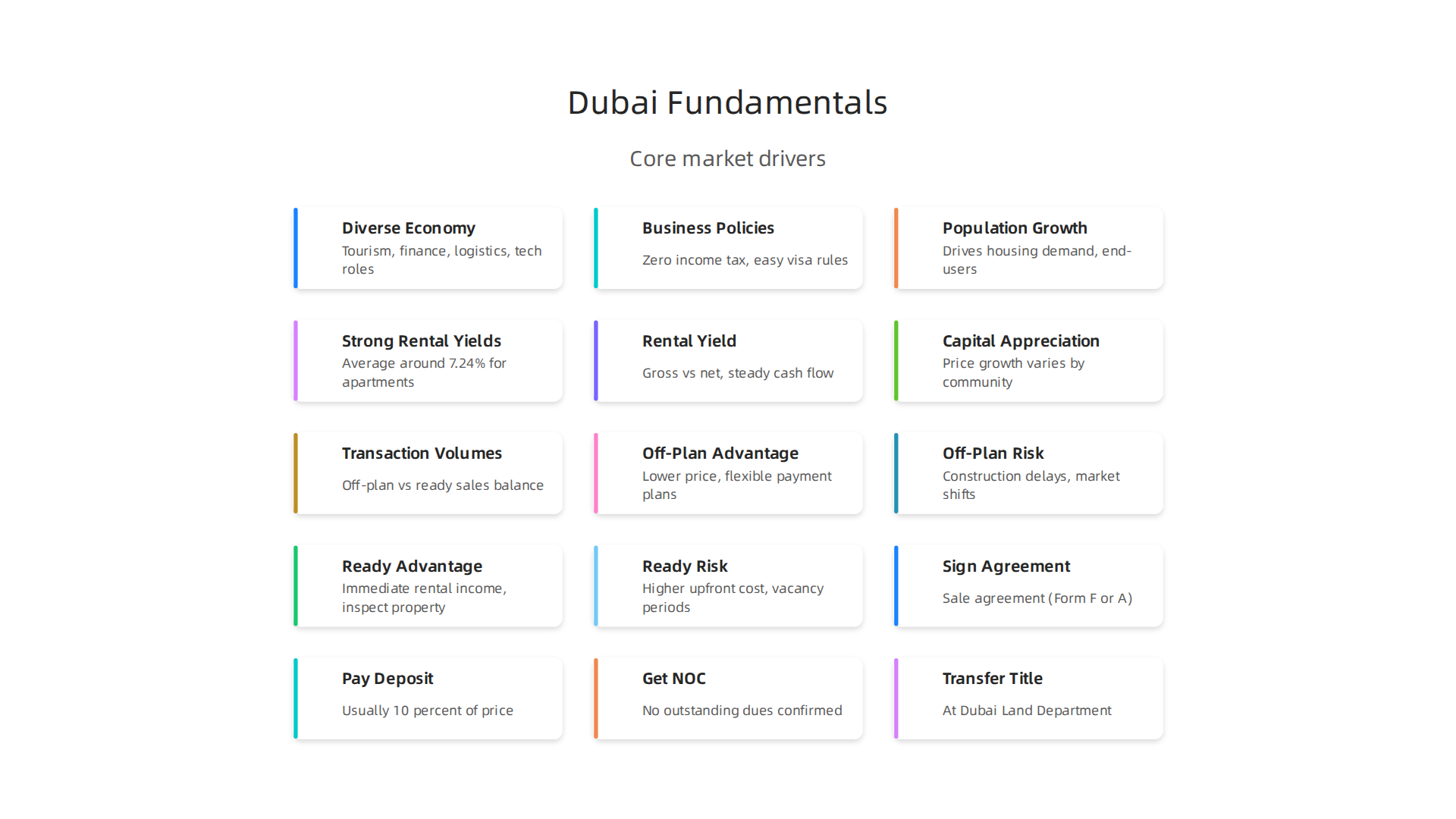
The economy is diverse. It is not just oil anymore. Tourism, finance, logistics, and tech all play big roles. The government keeps business-friendly policies like zero income tax and easy visa rules. This attracts high-net-worth individuals and skilled expats from all over the world.
Population growth drives housing demand. More people means more need for homes. And these people are not just passing through. Many are settling down, buying property, and starting families. This creates a stable base of end-users, which is good for investors.
Now let us look at the numbers. Rental yields in Dubai are still strong. According to the UAE Residential Property Market Analysis 2026, apartment yields average around 7.24%. Compare that to cities like London or New York where yields are often below 4%. That is a big difference. For investors in Dubai real estate, this means steady cash flow even if prices do not shoot up quickly.
What about price growth? The boom from 2022 to early 2025 was huge, with prices rising about 60%. But that pace is cooling. Forecasts for 2026 point to more moderate gains. The Property Price Forecasts Dubai (2026) suggest capital appreciation of 3% to 5% for the full year. That is not a crash. It is a normal slowdown after a hot period. And over the next five years, cumulative growth of 20% to 25% is expected. That is still solid.
Supply is another piece of the puzzle. Developers are launching many new units, but actual handovers are often lower than promised. The Dubai Residential Supply & Delivery Outlook shows that in 2026, only about 48% of forecasted deliveries may actually happen. That limits oversupply risk and keeps prices from dropping sharply.
Long-term, the Dubai 2040 Urban Master Plan is a major driver. It aims to make the city more sustainable, with more green spaces, better public transport, and new development zones. Continued spending on infrastructure like the Expo City, new roads, and the airport expansion supports demand for both residential and commercial property.
So what does this mean for you as an investor? The market is not a wild ride anymore. It is maturing. But it still offers strong yields and steady appreciation for those who pick the right assets. If you want to go deeper, check out our data-backed insights and investment opportunities for 2026 to see which neighborhoods and property types are showing the most promise.
Understanding these fundamentals helps Dubai real estate investors make smarter choices. And when you know the big picture, you can invest with more confidence.

Key Metrics Every Dubai Real Estate Investor Must Track
So you know the big picture. Now it is time to look at specific numbers. If you do not track the right metrics, you are basically guessing. And guessing in a market this size can cost you a lot of money. Here are the key metrics every Dubai real estate investor should watch.
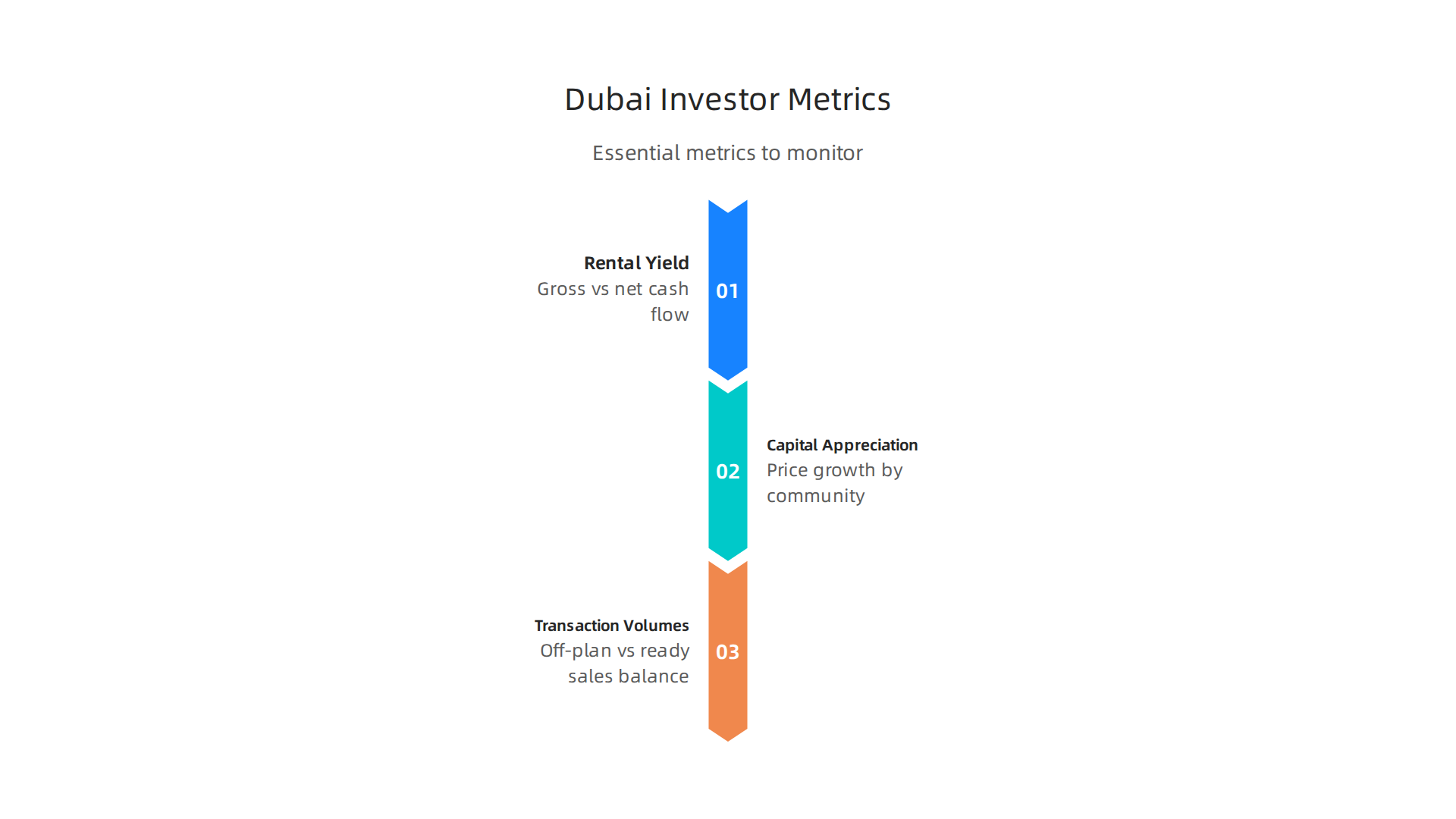
Rental Yield: Gross vs. Net
Rental yield is the yearly rent you earn as a percentage of the property price. Gross yield is the simple calculation: annual rent divided by purchase price. According to the Dubai Housing Market 2026 report, gross rental yields in Dubai average about 7% for apartments and 5% for villas. That is double what you get in many global cities.
But gross yield does not tell the whole story. Net yield subtracts costs like service charges, management fees, maintenance, and vacancy periods. For example, a unit with a 7% gross yield might only give you 5.5% net after all expenses. Always ask for net yield numbers before you commit.
Another useful number is the price-to-rent ratio. It shows how many years of rent it would take to cover the purchase price. A lower ratio is better. In Dubai, this ratio is quite attractive compared to London or Hong Kong.
Capital Appreciation Varies by Community
Not all areas grow at the same speed. Villa communities like Palm Jumeirah and Emirates Hills have seen huge price jumps since the pandemic. In fact, the same Engel & Voelkers report notes that villa prices in Dubai have risen over 200% since 2020. Apartments have also gone up, but at a slower rate.
For investors, this means you can choose a strategy. Do you want high rental income from apartments in areas like Dubai Marina or JLT? Or do you prefer strong price growth from villas in established communities? Some areas offer both. For example, new communities in Dubai South or Dubai Hills Estate show solid rental demand and steady appreciation.
Transaction Volumes: Off-Plan vs. Ready
Transaction volume is the pulse of the market. When volumes are high, it shows strong demand. When they drop, it can signal a slowdown. The Engel & Voelkers article also reports that 2025 was a record year with over 200,000 residential sales transactions. But here is the catch: many of those were off-plan sales.
Off-plan properties now make up about 73% of all transactions. That is a high number. It means more investors are buying before construction is finished. When the market shifts, off-plan buyers can face more risk. Ready properties, on the other hand, give you immediate rental income and lower uncertainty.
Watching the split between off-plan and ready sales helps you understand market sentiment. If off-plan share keeps rising, it may mean investors are speculating. If ready sales pick up, it suggests end-users are active.
To track these numbers accurately, you need reliable data tools. The Dubai Land Department’s DXB Interact portal gives verified transaction records. For deeper analysis, you can invest smarter with real-time market data from platforms like Property Monitor.
Putting It All Together
Track rental yields, price growth per community, and transaction volumes. These three metrics give you a clear picture of where the market is heading. If you are not sure where to start or want a second opinion, book a FREE Dubai Real Estate Consultation with us.
Off-Plan vs Ready Properties: Risk-Reward Decision Framework
Every dubai real estate investor asks this question at some point. Should you buy off-plan or go for a ready property?
The answer depends on your goals, your timeline, and the risk you are comfortable with.
Off-plan properties let you buy at a lower price with flexible payment plans. The trade-off is you wait two to four years for construction to finish. During that time, you earn zero rental income. According to the Off-Plan vs Ready Property Dubai | Investment Comparison Guide, off-plan buyers typically pay 15 to 25 percent less than the current market rate. That is a real advantage. But you also take on developer risk and possible construction delays.
Ready properties cost more upfront. You pay the full price or arrange a mortgage right away. The upside is you get immediate rental income. The same guide shows ready properties deliver steady yields of 6 to 8 percent from day one. You also see exactly what you are buying. No guesswork about the final finish or layout.
What Risks Come with Each Option
Off-plan carries three main risks. First, construction delays can push your handover back by months or even a year. Second, the market could shift while you wait. A downturn might leave your property worth less than you paid. Third, the developer could face financial trouble.
Dubai has protections in place for investors in dubai real estate. The Real Estate Regulatory Agency, or RERA, requires developers to use escrow accounts. Your money sits in a protected account and is released only as construction milestones are met. The Oqood registration system also records your off-plan purchase with the government. These rules help, but they do not remove all risk. You still need to check the developer’s track record carefully.
Ready properties have fewer unknowns. The building exists. You can inspect it. The rental market is clear. But the risks are different. You need more cash upfront. You also face vacancy periods when the property sits empty between tenants. And you are responsible for maintenance costs and service charges right away. That is where good property management services can help keep your investment running smoothly.
How to Match the Choice to Your Situation
The Off-Plan vs Ready Property: ROI Analysis for Smart Investors shows that over five years, both strategies can deliver 40 to 50 percent total ROI. The difference is how you get there. Off-plan relies on price growth. Ready properties combine rental income with slower appreciation.
Here is a simple way to decide. If you want lower costs upfront and can wait, choose off-plan. If you need cash flow now and prefer less uncertainty, pick a ready home. And if you are not sure, many investors in dubai real estate build a mix of both types in their portfolio.
Before you commit to any deal, understand how Dubai’s rules protect buyers. Read our guide on how DLD and RERA protect your property investment to learn what safeguards are in place. Knowledge like this helps you make confident choices every time.
Navigating Dubai’s Legal & Regulatory Landscape as a Foreign Investor
You already know Dubai is one of the easiest places in the world for foreign buyers to own property. But easy does not mean automatic. You need to understand the rules before you buy.
Here is the big one. Foreign investors can own property in designated freehold zones with full ownership rights. That means you get a title deed in your name. You can sell the property, lease it, or live in it with no restrictions. Popular freehold areas include Downtown Dubai, Palm Jumeirah, Dubai Marina, and Arabian Ranches. The guide on Dubai freehold zones for foreign buyers explains exactly where you can buy and what rights you get.
The Buying Process Step by Step
Once you pick a property, the legal process follows a clear path.
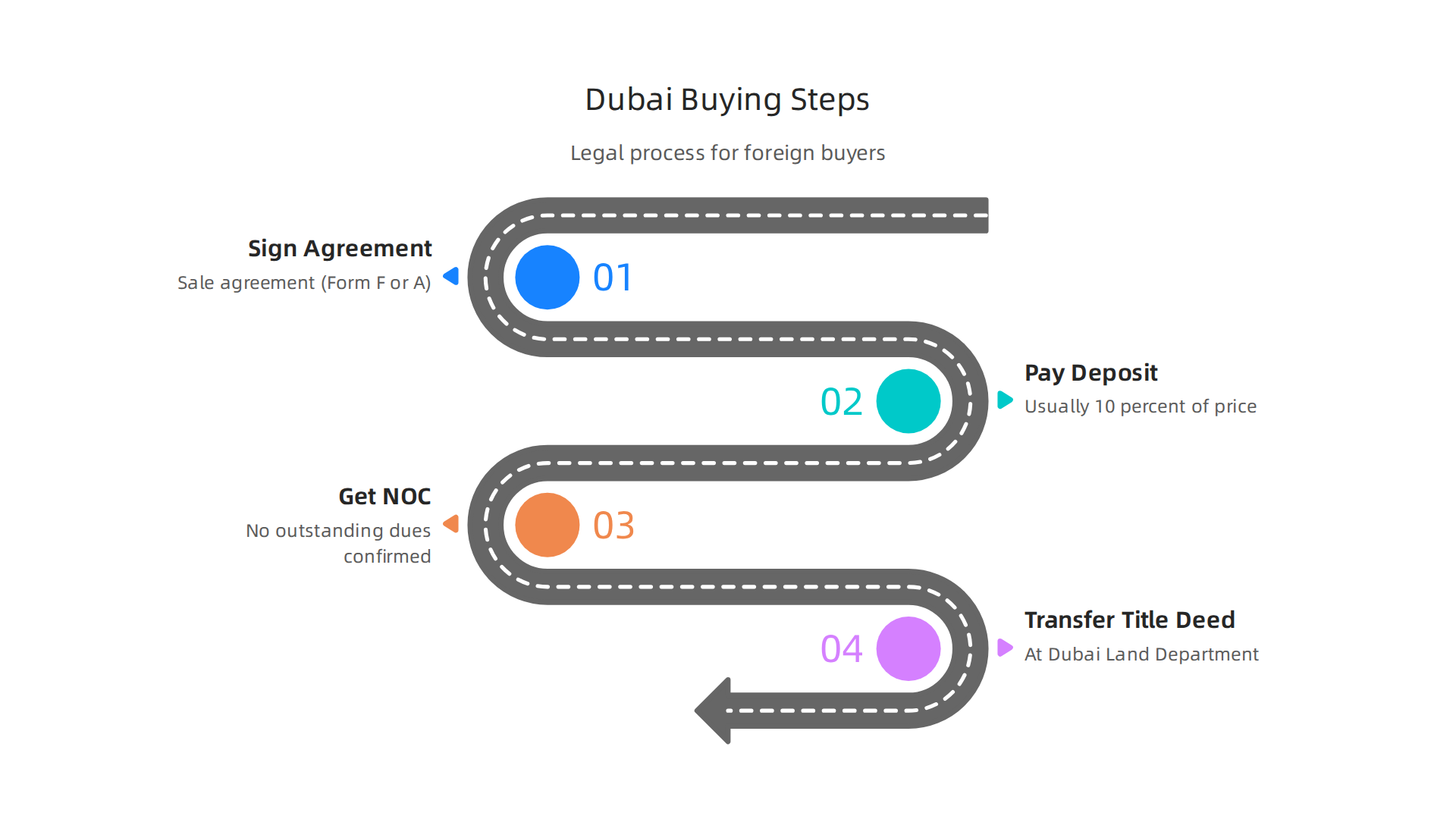
You sign a sale agreement, also called a Form F or Form A for off-plan units. Then you pay the deposit, usually 10 percent of the price. The seller or developer issues a No Objection Certificate, or NOC, to confirm there are no outstanding dues. After that, you transfer the title deed at the Dubai Land Department.
Here is the cost to know. DLD charges a transfer fee of 4 percent of the purchase price. On a AED 1 million property, that is AED 40,000. The buyer pays this fee. According to the 2026 guide for property buyers in Dubai, there are no annual property taxes or capital gains taxes in Dubai. That is a major reason why investors in dubai real estate keep coming back.
Regulations That Protect You
The Real Estate Regulatory Agency, or RERA, oversees the entire market. Every real estate broker needs a RERA license to operate legally. If you buy off-plan, the developer must use an escrow account. Your money goes into that account, and funds are released only when construction reaches specific milestones. This rule protects you from unfinished projects.
Another major perk is the Golden Visa program. If you invest AED 2 million or more in property, you can get a 10 year renewable residency visa. The latest data shows that Dubai golden visa eligibility for property investors now starts at AED 750,000 for certain visa options. This makes long term residency much more accessible.
What You Must Not Skip
Anti-money laundering rules apply to all property purchases. You will need to show proof of where your money comes from. Banks and developers ask for bank statements, proof of income, and source of funds documents. This is standard practice and should not slow you down if you have clean records.
If you want a complete walkthrough of the ownership process, read our freehold property guide for foreign investors. It covers every document you need and every step from offer to title deed.
And if you are ready to start your search with expert help, book a FREE Dubai Real Estate Consultation with Ayaz Salman. One conversation can save you weeks of research.
Building a Diversified Dubai Property Portfolio
You know investing in a single property can work well. But the smartest move for any serious investor is to build a portfolio that spreads risk across different assets, locations, and strategies. This is exactly what separates casual buyers from experienced investors in Dubai.
Think of it like a balanced diet. You do not eat only one food group. You mix proteins, vegetables, and grains. The same logic applies to your investments real estate portfolio. You want some properties that generate monthly rental income and others that grow in value over time. According to the guide on building a profitable real estate portfolio in Dubai in 2026, a well-structured portfolio typically aims for 40 to 50 percent in high-yield rental assets and 25 to 35 percent in capital appreciation properties. The rest goes into off-plan deals and highly liquid units you can sell quickly.
Mix Asset Types and Locations
Do not put all your money into one type of property. Apartments near the Dubai Metro often deliver strong rental returns because business commuters and young professionals want easy access to public transport. Villas in communities like Arabian Ranches or Dubai Hills Estate attract families looking for space and lifestyle. Commercial units such as small retail shops or offices can add a third layer of income that behaves differently from residential demand.
Location diversification matters just as much. Communities driven by tourism, like those near Palm Jumeirah or Dubai Marina, perform differently than areas driven by corporate relocation, such as Dubai Silicon Oasis or Business Bay. Spreading your capital across these different demand drivers reduces your risk if one segment slows down. The complete guide on asset allocation for a high-performing investment property portfolio recommends balancing higher-yield assets for income with growth-focused assets for long-term equity building.
Balance Off-Plan and Ready Properties
Another smart move is mixing off-plan deals with ready properties. Off-plan units let you enter at a lower price with flexible payment plans. They offer strong appreciation potential between purchase and handover. Ready properties give you immediate rental income that starts flowing from day one.
Your personal situation decides the mix. If you need cash flow now, lean toward ready properties. If you can wait a few years for bigger gains, add more off-plan deals to your portfolio. The data shows that studios and one-bedroom apartments near business hubs can generate gross rental yields of around 7 percent, while villa yields average about 5 percent. These numbers are roughly double what you would earn in mature markets like London or New York.
Plan Your Exit Early
Portfolio building is not just about buying. It is also about knowing when and how to sell. Decide your time horizon before you buy. Are you holding for five years or fifteen? Are you focused on capital gains or steady income? Your answer shapes every decision from property choice to financing.
If you plan to use a mortgage, remember that non-resident buyers need a minimum deposit of around 20 percent for properties under AED 5 million. Factor this into your cash flow planning. Leverage can help you scale faster, but it also adds risk if the market shifts.
A well-built portfolio gives you flexibility, steady income, and long-term wealth. Start with one solid property, then add more over time as you learn the market. You do not need to build everything at once. Slow and steady wins this race.
Where to Find Reliable Data & Avoid Information Overload
The Dubai real estate market moves fast. Every day you see new posts on Instagram, WhatsApp groups buzzing with "hot deals," and YouTube analysts predicting the next crash or boom. It is easy to feel overwhelmed by noise.
But here is the truth: not all data is equal. Some sources show what sellers want you to see. Others show what actually happened.
Your job is to pick the right sources and ignore the rest.
Start with the Official Data
The Dubai Land Department (DLD) runs an online portal called DXB Interact. This is the single most accurate source for verified sale transactions. Every registered deal flows through DLD. If you want to know what someone actually paid for a unit in your target building, check DXB Interact first.
For deeper market analysis, two paid platforms stand out: Property Monitor and REIDIN. Property Monitor publishes its Dynamic Price Index each month, which tracks real price changes across communities. REIDIN provides institutional-grade data used by banks and large investors.
A helpful review of the Dubai real estate websites data source review explains that DXB Interact is free and updated weekly, while Property Monitor and REIDIN offer valuation-grade insights for serious investors.
Major consultancies like CBRE, Knight Frank, and JLL also release quarterly reports. These are excellent for understanding broad market trends, but remember they lag by 4 to 8 weeks.
Watch Out for Social Media Traps
Listing portals like Property Finder and Bayut show asking prices, not final sale prices. Asking prices in Dubai can be 5 to 12 percent above what a property really sells for. Treat those numbers as ceilings, not benchmarks.
Unverified social media posts and paid influencers often promote specific developers or off-plan projects without disclosing the full picture. Cross-check everything against DLD records or trusted analytics platforms.
The smartest investors in Dubai real estate use at least two sources to confirm any pricing claim.
Save Time with Curated Tools
You do not have to check five different websites every day. Subscribe to free monthly reports from Property Monitor or REIDIN. Sign up for newsletters from industry leaders like Arabian Business or DLP.
If you want a single dashboard that pulls DLD data and Property Monitor trends together, the guide to invest smarter with real-time market data is a good starting point.
The Bottom Line
Reliable data keeps your decisions grounded. Use official records, verified platforms, and trusted consultancies. Avoid the hype. And when you want personalized guidance based on real numbers, consider a professional review of your strategy.
FREE Dubai Real Estate Consultation
The Role of Expert Advisors & Property Managers
Data gives you the map, but you still need someone who knows the streets. That is where expert advisors and property managers come in. Even the most dedicated investors in Dubai real estate find that working with the right people saves time, money, and stress.
Why a Licensed Advisor Matters
A RERA-certified real estate advisor does more than show you listings. They bring local knowledge you cannot get from a spreadsheet. They know which buildings have maintenance problems, which landlords are difficult to deal with, and which off-plan projects have strong developer track records.
Good advisors also get access to off-market deals. These are properties never listed on public portals. For serious investors, off-market opportunities often mean better pricing and less competition.
An advisor who understands your goals can also negotiate better terms. In Dubai, skilled negotiators often secure price reductions of 2 to 5 percent, plus flexible payment plans. That kind of saving adds up fast on a 2 million AED property.
If you want to learn what to look for in a partner, the guide on how to choose a real estate broker in Dubai walks through the exact questions to ask before signing up.
What Property Managers Actually Do for You
If you live outside Dubai or simply do not want to deal with daily tenant issues, property management services are essential. A good manager handles tenant sourcing, background checks, rent collection, maintenance coordination, and legal compliance with the Dubai Land Department.
For absentee investors, this is peace of mind. You do not have to wake up at 3 a.m. to fix a broken AC. Your property manager handles it.
The standard fee for long-term rental management in Dubai ranges from 5 to 10 percent of annual rental income, as explained in the breakdown of property management fees in Dubai. That fee typically covers everything from marketing vacancies to handling evictions if needed.
For short-term rentals like Airbnb, fees run higher, often 15 to 25 percent. But the income potential can also be higher in popular areas like Dubai Marina or Downtown.
How to Pick the Right Partner
Not all advisors and managers are the same. Here is what to watch for:
- Check their RERA license number. Every licensed agent in Dubai has a registration number you can verify on the RERA website.
- Ask about fee transparency. Some advisors charge a commission from the seller. Others work fee-only. Make sure you understand the structure before starting.
- Request references. A good property manager should give you contact details for current clients.
- Review the management agreement carefully. Look for clauses about notice periods, lease renewal fees, and maintenance spending limits.
A step-by-step guide to finding a trustworthy estate agency in Dubai covers the red flags and green flags in more detail.
The Bottom Line
You can do everything alone. But most people who succeed as dubai real estate investors build a team.

A licensed advisor finds the right deals. A property manager keeps those deals running smoothly.
If you want personalized guidance based on your specific goals, connect with Ayaz for a FREE Dubai Real Estate Consultation and get expert advice tailored to your situation.
Summary
This guide gives a practical, data-driven roadmap for investing in Dubai real estate in 2026, explaining why the market still attracts international buyers and how to make smart choices. It covers market fundamentals—strong rental yields, moderated price growth forecasts, and supply dynamics—then breaks down the specific metrics investors must track, like gross vs net yield, price growth by community, and off‑plan versus ready transaction volumes. You’ll get a clear framework to evaluate off‑plan and ready purchases, a step‑by‑step view of the legal and regulatory process for foreign buyers, and tactics for building a diversified portfolio that balances income and appreciation. The article also points to the best official and paid data sources, warns about social media noise, and shows when to hire licensed advisors and property managers. Read it to know what numbers to check, how to limit risk, and which local tools and partners will help you invest with confidence.